How Poor Tokenomics Wrecked the $OM Token — A Case Study in Vesting, Emissions & Buybacks
Mantra's $OM token did a 1:4 rebrand swap after a collapse driven by poor vesting schedules, rising emissions, and a buyback mechanism that couldn't save a structurally broken model. Here's what went wrong.

Ashish Homkar
Founder & CEO
- Published
- Reading time
- 6 min read
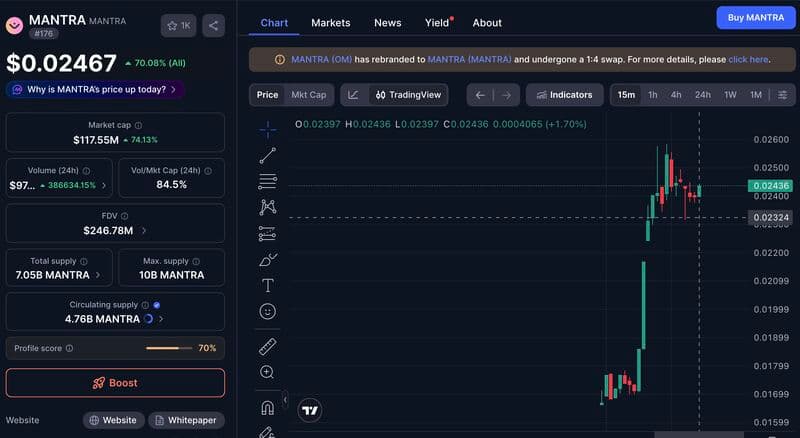
Mantra recently announced that its $OM token would undergo a 1:4 swap as part of a rebranding effort. For those tracking the project, this wasn't a surprise. The signs were in the tokenomics long before the swap announcement.
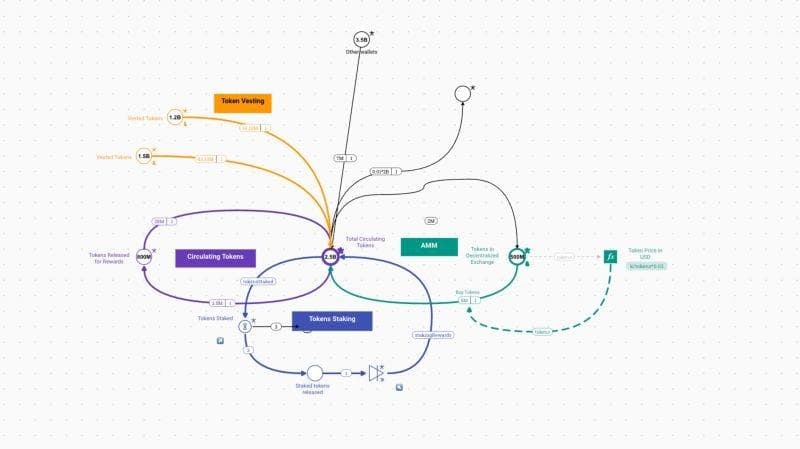
Blockphrase conducted a token audit on $OM in 2025. What we found was a model under significant structural pressure — and the market eventually confirmed what the model was already telling us.
The Setup: A Well-Funded Project With a Fragile Model
Mantra raised substantial capital and had a credible RWA narrative at a time when real-world asset tokenization was gaining genuine institutional interest. The team was visible, the partnerships were real, and the market was receptive.
But beneath the narrative, the token model had three compounding problems.
Problem 1: Vesting Schedules That Kept Expanding
Token vesting is supposed to create predictability. It tells the market: here's when supply will be released, here's who holds it, here's what the unlock pressure looks like over time.
When vesting schedules expand — when cliffs get extended, when allocations get restructured — it signals one of two things: the team is buying time, or the original model was wrong. Neither is good for price discovery.
In $OM's case, the vesting schedule appeared to be in constant motion. Markets don't price uncertainty well. Expanded vesting creates a persistent overhang — even if tokens haven't unlocked yet, the market discounts them now.
Problem 2: Emissions Rising With No Corresponding Demand Sink
This is the core of the problem. Token emissions are a cost. Every token that enters circulating supply is a unit of sell pressure unless there's a mechanism that absorbs or locks that supply.
For $OM, the primary utility was staking. Which means:
- If users stake: emissions are deferred, not eliminated. The sell pressure is parked, not destroyed.
- If users don't stake: they sell. Every emission event becomes a sell event.
- If emissions unlock alongside declining sentiment: you get a cascading effect where holders de-stake and sell simultaneously.
The supply model had no mechanism that created permanent demand proportional to emission velocity. Staking alone doesn't close that loop — it just controls the timing of when pressure hits the market.
Problem 3: The Buyback Wasn't Enough — and the Swap Wasn't the Answer
Buyback and burn mechanisms are valuable when they're sized correctly relative to emission pressure and when the treasury funding them is durable. For $OM, the buyback was a better solution than the 1:4 swap that eventually came.
Here's why the swap was the wrong move: printing more tokens does not solve bad tokenomics.
A 1:4 swap changes the nominal supply structure. It does not change the underlying economic model. The emission schedule, the vesting dynamics, the utility concentration risk — all of that carries over. You've essentially restarted the clock without fixing the engine.
The correct intervention would have been:
- Aggressive supply-side restructuring — reduce emission rates, extend vesting with genuine lockups, not deferrals.
- Utility expansion — identify and build utility sinks that create demand independent of price appreciation.
- Treasury-funded buyback at scale — if the buyback was too small to make a structural difference, the treasury allocation was wrong from day one.
A token rename and ratio change doesn't restore confidence. Economic redesign does.
What the $OM Audit Showed
The Blockphrase audit of $OM identified several structural concerns, including:
- Emission rate vs. demand imbalance — supply growth was outpacing organic demand signals.
- Single-utility risk — staking as the primary utility creates binary outcomes: either everyone stakes and emissions are parked, or nobody does and they sell.
- Vesting opacity — the schedule changes created uncertainty that markets priced in negatively.
- Buyback sizing — the mechanism was conceptually sound but insufficiently scaled to absorb emission pressure at the observed rates.
These aren't unusual findings. They're representative of a category of token models that get designed around the raise rather than around the economics.
The Broader Lesson
$OM is not an isolated failure. It's a data point in a pattern.
Projects that raise capital on narrative, design tokenomics around investor expectations rather than economic fundamentals, and launch with insufficient stress testing tend to follow a predictable arc:
- Strong launch metrics driven by incentives
- TVL and price stability while emissions are high and sentiment is positive
- Gradual decay as emission pressure exceeds organic demand
- Crisis event — a liquidity contraction, a macro downturn, or a whale exit — that exposes the underlying model
- Emergency measures — swaps, rebrands, vesting changes — that address symptoms rather than causes
The honest takeaway: get a tokenomics advisor before you launch. Not to validate your existing model — to stress test it, find the failure modes, and redesign before the market finds them for you.