MiCA Token Classification: A Founder's Guide
How MiCA classifies a token as an ART, EMT or other crypto-asset, what falls outside it, and what each class requires before launch, as of October 2026.
Blockphrase Team
- Published
- Reading time
- 10 min read
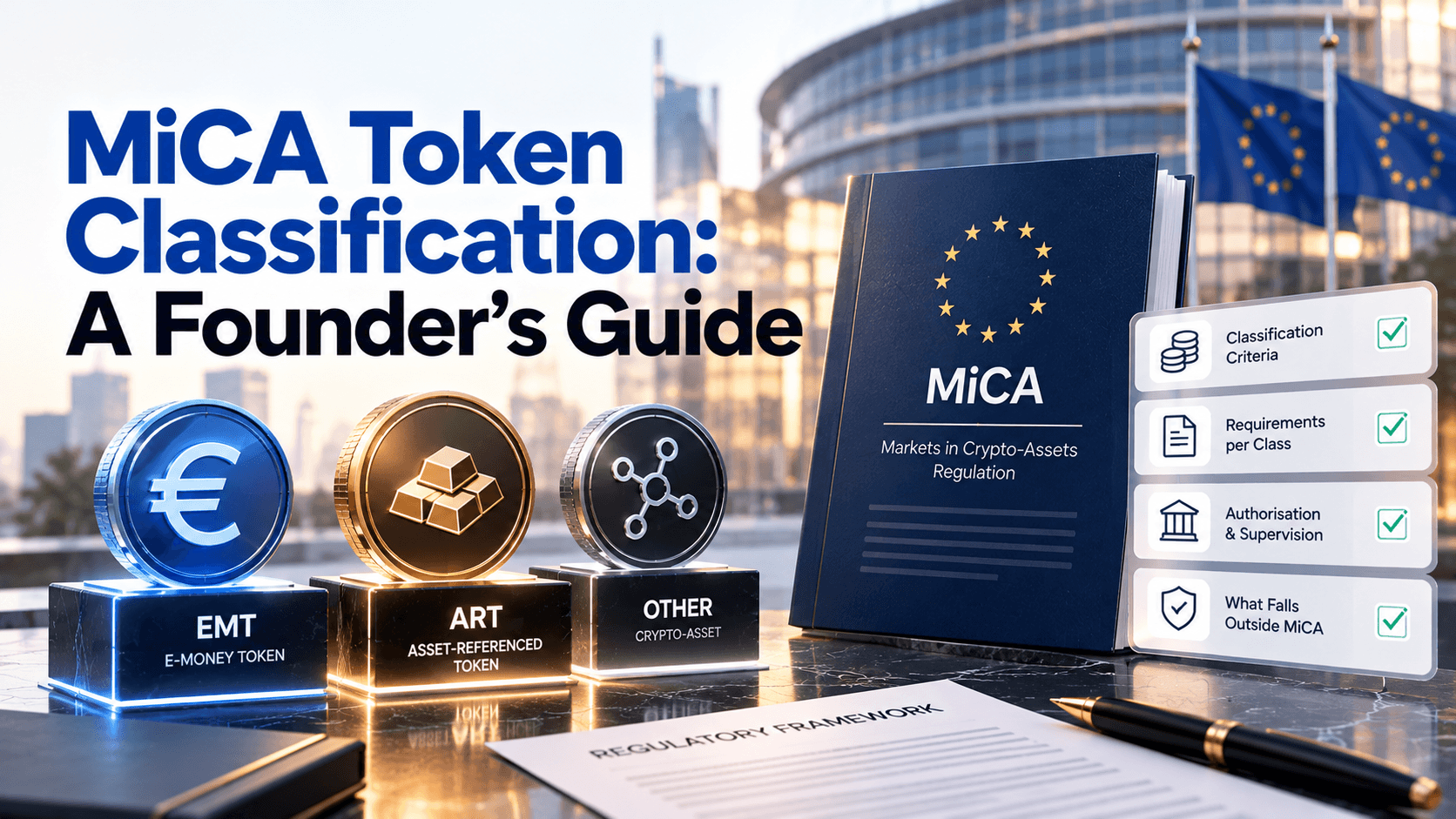
Under MiCA (Regulation (EU) 2023/1114), a token in scope is an e-money token (EMT) if it aims to hold a stable value by referencing one official currency, an asset-referenced token (ART) if it references any other value, right or basket, and otherwise an "other crypto-asset", which includes utility tokens. Financial instruments, deposits and unique non-fungible crypto-assets fall outside MiCA entirely.
Current as of October 2026.
What Counts as a Crypto-Asset Under MiCA?
MiCA defines a crypto-asset as "a digital representation of a value or of a right that is able to be transferred and stored electronically using distributed ledger technology or similar technology" (MiCA Article 3(1)(5)). Under the joint EBA, EIOPA and ESMA guidelines, a token is non-transferable only if it is accepted solely by the issuer or offeror and holders have no technical way to transfer it (Joint ESA Guidelines JC 2024 28, paragraphs 18-20).
Which Crypto-Assets Fall Outside MiCA?
Article 2 sets three kinds of exclusion:
- Unique, non-fungible crypto-assets (Article 2(3)).
- Assets already covered by other EU law (Article 2(4)): financial instruments; deposits, including structured deposits; funds, unless they qualify as e-money tokens; securitization positions; insurance and reinsurance products; pension products and schemes; and social security schemes.
- Certain persons (Article 2(2)), such as central banks acting as monetary authorities and public international organizations.
The NFT exclusion is narrow. Under ESMA's guidelines on crypto-assets as financial instruments (Guideline 8), a unique identifier or NFT standard does not prove uniqueness, items in a series with a common trading price may not qualify, and fractionalized NFTs are not automatically unique.
When Is a Token a Financial Instrument Instead?
MiCA left the criteria to ESMA (Article 2(5)). Its guidelines, dated 19 March 2025, have applied since 19 May 2025 (ESMA75453128700-1323; FIN-FSA):
- Substance over form. The technological format is "not a determining factor", and tokenized financial instruments stay financial instruments (Guidelines 1 and 2).
- Transferable securities: three cumulative tests. Not an instrument of payment, part of a "class" of interchangeable units, and negotiable. A temporary lock-up does not defeat negotiability (paragraphs 15-30).
- Rights decide. Dividends, liquidation claims or votes on corporate matters such as electing the board are share-like; governance limited to protocol upgrades or fee settings is not. Interest or a promise to repay principal is bond-like (paragraphs 21-26).
- Expectation of profit is not enough. Hoping the price rises does not make a utility token a financial instrument (paragraphs 23 and 62).
- Not only securities. A token can be a unit in a collective investment undertaking if it pools investors' capital under a defined investment policy for a pooled return (Guideline 4), or a derivative, such as a perpetual future or a synthetic-exposure token (Guideline 5). Money-market instruments and emission allowances have their own tests (Guidelines 3 and 6).
- Hybrids go to MiFID II first. Financial-instrument features take precedence, and attributes outweigh the issuer's label, including functions that change over the token's life (Guideline 9).
A financial instrument is offered under EU securities law, not MiCA.
How Does MiCA Classify a Token Inside Its Scope?
For a token that is a crypto-asset and not excluded, the joint ESA test runs in a fixed order (JC 2024 28, paragraph 23):
- Does it purport to maintain a stable value by referencing only one official currency? Then it is an EMT (Title IV).
- If not, does it purport to maintain a stable value by referencing another value or right, or a combination, including several currencies? Then it is an ART (Title III).
- If neither, it is an other crypto-asset under Title II.
A utility token is a subtype of the third category, "only intended to provide access to a good or a service supplied by its issuer" (Article 3(1)(9)). Governance tokens and meme coins also fall in Title II, provided they are not financial instruments.
What Does Each Classification Trigger Before Launch?
| Other crypto-asset (incl. utility) | Asset-referenced token (ART) | E-money token (EMT) | |
|---|---|---|---|
| Defining feature | Not stable-value referenced | Stable value against other values or a basket | Stable value against one official currency |
| Who may offer | Any legal person | Authorized issuer or credit institution (others with its consent) | Credit institution or e-money institution (others with its consent) |
| Regulator's role | Notification only, no approval | Authorization, white paper approved | License; white paper notified |
| Classification document | Explanation (Art. 8(4)) | Legal opinion (Arts. 17, 18) | No ESA template |
| Main exemptions | Under 150 persons per state, EUR 1m in 12 months, qualified investors | EUR 5m average outstanding or qualified investors only (white paper still notified) | Electronic Money Directive exemptions (white paper still notified) |
| Interest to holders | No MiCA ban; may make it bond-like | Prohibited | Prohibited |
| Significant tier | None | EBA supervision | EBA supervises Arts. 55 and 58 for e-money institutions |
Other crypto-assets and utility tokens
The offeror must be a legal person that draws up, notifies and publishes a white paper (Article 4(1)). It goes to the home regulator at least 20 working days before publication, with an explanation of why the token is not excluded, not an EMT and not an ART. No prior approval may be required (Article 8(3)-(5)), and the first page says the paper "has not been approved by any competent authority" (Article 6(3)). Since 23 December 2025 it must be filed in iXBRL format (ESMA).
Offers to fewer than 150 persons per member state, under EUR 1,000,000 over 12 months, or only to qualified investors who alone can hold the token skip the white paper. Tokens offered for free, validation rewards, utility tokens for an existing good or service, and limited merchant networks sit outside Title II. A token is not free if recipients must provide personal data or the offeror receives any fee, commission or other benefit for it (Article 4(2)-(3)). Announcing an intention to seek admission to trading cancels those exemptions (Article 4(4)), and a utility token for a service not yet in operation can be offered for at most 12 months (Article 4(6)). Admission to trading also requires a notified white paper, which the trading platform can agree in writing to prepare (Article 5).
Asset-referenced tokens
Only an issuer authorized under Article 21 or a credit institution meeting Article 17 may offer an ART or seek its admission to trading (Article 16). A credit institution notifies its regulator at least 90 working days before first issuance and has its white paper approved (Article 17). Both routes need a legal opinion that the token is neither excluded nor an EMT (Article 17(1)(b)(ii); Article 18(2)(e)). Below EUR 5,000,000 average outstanding over 12 months, or for qualified-investor-only offers, no authorization is needed, but a white paper must still be drawn up and notified (Article 16(2)). Issuers may not pay interest on ARTs (Article 40).
E-money tokens
Only a credit institution or an electronic money institution may issue an EMT, after notifying and publishing a white paper and giving its regulator 40 working days' notice. EMTs are deemed electronic money (Article 48), and interest is prohibited (Article 50).
Significant ARTs and EMTs
The EBA classifies a token as significant when at least three of seven criteria are met, such as more than 10 million holders, more than EUR 5 billion in value or reserves, or more than 2.5 million transactions and EUR 500 million a day (Article 43; Article 56). The EBA then supervises a significant ART issuer and, for an e-money institution's significant EMT, compliance with Articles 55 and 58 (Article 117).
What Must the Classification Explanation or Legal Opinion Contain?
Article 97(1) required the three authorities to publish templates and a standardized test, which they issued on 10 December 2024 (ESMA). The guidelines have applied since 12 May 2025 (JC 2024 28). In practice:
- Annex A templates the Article 8(4) explanation filed with a Title II white paper; Annex B templates the ART legal opinion.
- Every field should be completed, with references to the EU and national law relied on, case law, regulator guidance and ESA guidelines (paragraphs 12-15).
- The ART legal opinion may come from an in-house or external legal adviser with evidence of professional standing (paragraph 16).
- Market participants "must make every effort to comply" (paragraph 1).
Where Do the Transitional Regimes Stand in October 2026?
- CASP grandfathering has ended. Firms serving clients under national law could continue until 1 July 2026 at the latest, or earlier where a member state shortened the period (Article 143(3)). ESMA expects unauthorized providers to stop onboarding and wind down (ESMA public statement, 23 June 2026), so any platform listing your token for EU clients must now be MiCA-authorized.
- Legacy tokens have until the end of 2027. For Title II tokens admitted to trading before 30 December 2024, trading platforms must ensure a compliant white paper by 31 December 2027 (Article 143(2)).
- Non-compliant stablecoins are being removed. On 8 October 2026, ESMA published an opinion (ESMA75-113276571-1742) saying authorized CASPs should stop serving EU clients in non-compliant ARTs and EMTs, with national regulators requiring remediation within three months (ESMA).
- The review is open. The Commission's consultation closed on 30 September 2026 (European Commission), and its report is due by 30 June 2027 (Article 140). ESMA, which has issued only one non-binding classification opinion, proposed binding ESA classification opinions, including on hybrids (ESMA response, 30 September 2026). The Market Integration and Supervision Package, still under negotiation, would amend MiCA to put significant CASPs under direct ESMA supervision (Council of the EU, 5 October 2026). None of these is law yet.
Where Do Founders Get Classification Wrong?
- Adding revenue share later. A fee-share or distribution feature added after launch can move a utility token toward a transferable security, because ESMA looks at the token over its life (Guideline 9).
- Pegging "just for stability". A stable-value design is an EMT if it references one official currency and an ART if it references anything else, such as a commodity, another crypto-asset or a basket (Article 3(1)(6)-(7)).
- Calling a data-for-tokens airdrop free. Collecting personal data in exchange for tokens takes the offer out of the free exclusion (Article 4(3)).
Settle classification before the design is finalized and the smart contracts are written.
Blockphrase checks every token design against MiCA, VARA, RBI and SEBI requirements before launch, and a tokenomics audit with a MiCA classification check reviews regulatory risk alongside economic risk. See also our digital asset advisory work and five-step methodology. If you are unsure a token is needed at all, read how to know if your project needs a token. To check your model before launch, book a scoping call.
Frequently Asked Questions
Is a governance token a financial instrument under MiCA?
Usually not, if its votes cover only technical matters such as protocol upgrades or fee settings. ESMA's 2025 guidelines treat governance over corporate decisions, such as electing board members or approving mergers, as equivalent to shareholder voting rights. Paired with dividends or a claim on liquidation proceeds, that pushes the token toward MiFID II instead.
Do NFTs sold as a large collection fall under MiCA?
They can. MiCA excludes only crypto-assets that are unique and not fungible, and ESMA says a unique identifier or token standard does not prove uniqueness. When an item's value comes mostly from comparison with similar items in its series, such as a shared floor price, regulators may treat the collection as fungible crypto-assets within MiCA.
Does a utility token need a white paper if the platform is not live yet?
Yes, unless another exemption applies. MiCA exempts utility tokens only when the good or service they unlock already exists or is in operation. For a platform still in development, the offeror files a white paper with the classification explanation, and the public offer can run for no more than 12 months from the white paper's publication.
Who can sign the legal opinion for an asset-referenced token?
An in-house or external legal adviser, under the joint ESA guidelines that have applied since 12 May 2025. The adviser must give the opinion objectively, free of conflicts that cannot be managed, and show evidence of professional standing to issue legal opinions, such as a diploma, practicing certificate or registration with the relevant professional body.
Can a startup issue a euro-pegged token without an e-money license?
Generally not. A token that aims to hold a stable value by referencing one official currency is an e-money token, which only a credit institution or electronic money institution may offer to the public. Narrow Electronic Money Directive exemptions exist but still need a notified white paper. A startup can offer a licensed issuer's token with its consent.
Sources
This guide is general information, not legal advice. Rules and regulator guidance change; check the primary sources below before acting.
- ESMA Interactive Single Rulebook: MiCA Article 2, Scope
- ESMA Interactive Single Rulebook: MiCA Article 3, Definitions
- ESMA Interactive Single Rulebook: MiCA Article 4, Offers to the public of crypto-assets other than ARTs or EMTs
- ESMA Interactive Single Rulebook: MiCA Article 5, Admission to trading
- ESMA Interactive Single Rulebook: MiCA Article 6, Content and form of the crypto-asset white paper
- ESMA Interactive Single Rulebook: MiCA Article 8, Notification of the crypto-asset white paper
- ESMA Interactive Single Rulebook: MiCA Article 16, Authorisation
- ESMA Interactive Single Rulebook: MiCA Article 17, Requirements for credit institutions
- ESMA Interactive Single Rulebook: MiCA Article 18, Application for authorisation
- ESMA Interactive Single Rulebook: MiCA Article 40, Prohibition of granting interest (ARTs)
- ESMA Interactive Single Rulebook: MiCA Article 43, Classification of significant ARTs
- ESMA Interactive Single Rulebook: MiCA Article 48, Requirements for e-money tokens
- ESMA Interactive Single Rulebook: MiCA Article 50, Prohibition of granting interest (EMTs)
- ESMA Interactive Single Rulebook: MiCA Article 56, Classification of significant EMTs
- ESMA Interactive Single Rulebook: MiCA Article 97, Promotion of convergence on classification
- ESMA Interactive Single Rulebook: MiCA Article 117, Supervisory responsibilities of EBA
- ESMA Interactive Single Rulebook: MiCA Article 140, Reports on the application of this Regulation
- ESMA Interactive Single Rulebook: MiCA Article 143, Transitional measures
- ESMA: Guidelines on the conditions and criteria for the qualification of crypto-assets as financial instruments (ESMA75453128700-1323)
- EBA, EIOPA and ESMA: Joint Guidelines on templates for explanations and opinions, and the standardised test for crypto-assets (JC 2024 28)
- ESMA: ESAs provide Guidelines to facilitate consistency in the regulatory classification of crypto-assets
- ESMA: Markets in Crypto-Assets Regulation (MiCA)
- ESMA: Public Statement on the end of the MiCA transitional period (23 June 2026)
- ESMA: ESMA sets out supervisory expectations on services related to unauthorised stablecoins
- ESMA: Response to the European Commission's consultation on the review of MiCA (30 September 2026)
- European Commission: Targeted consultation on the review of MiCA Regulation
- Finanssivalvonta (FIN-FSA): The European Supervisory Authorities have issued a number of guidelines regarding crypto-assets
- Council of the European Union: Market Integration and Supervision Package (MISP), General Approach (13777/26, 5 October 2026)
Want research like this applied to your project?
Related serviceWeb3 Strategy & Digital Asset Advisory