Crypto Market Maker Agreements: Key Terms
Crypto market maker agreements explained: retainer versus token loan and call option, the terms to include, and the red flags behind recent enforcement.
Blockphrase Team
- Published
- Reading time
- 8 min read
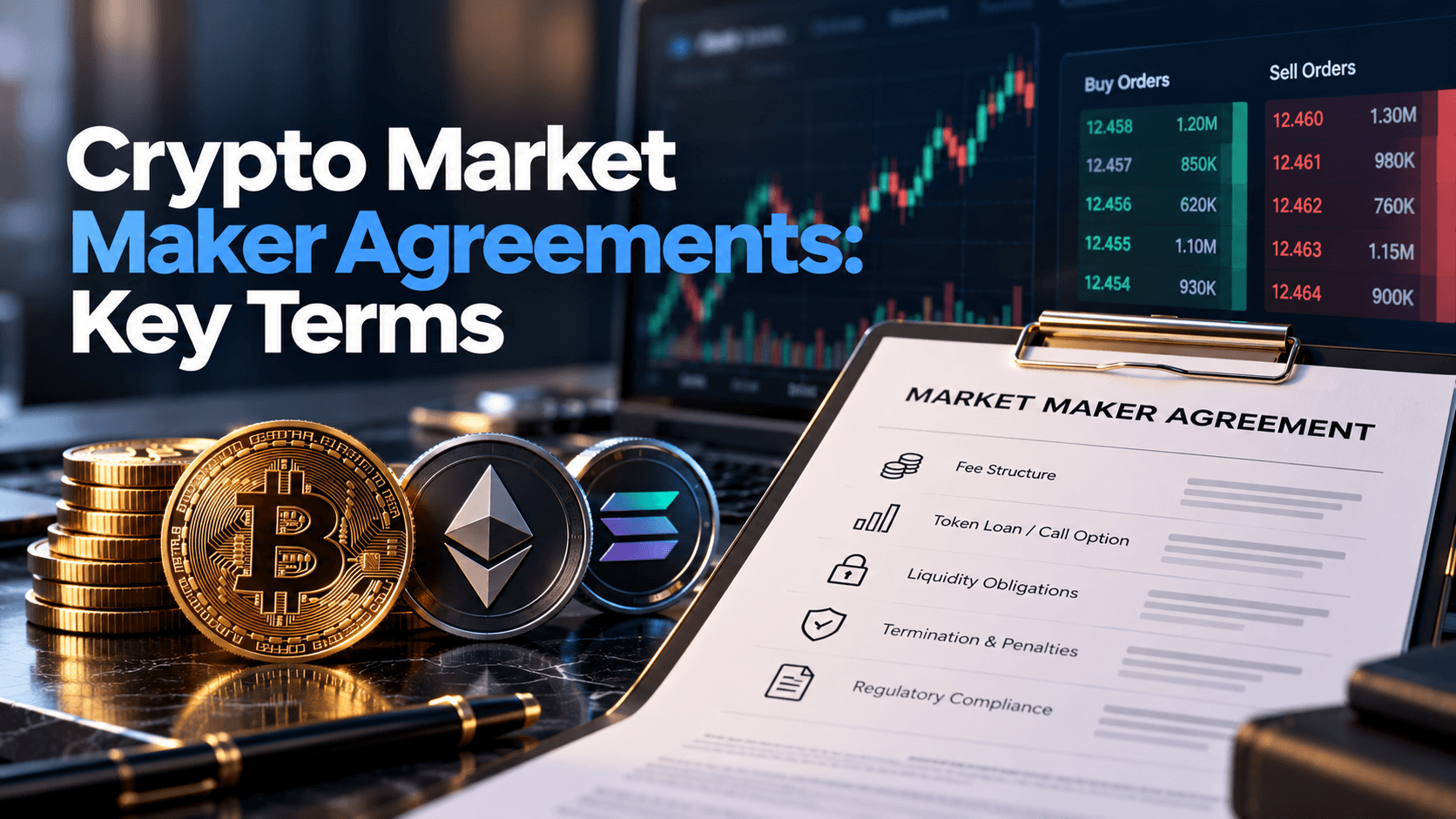
A crypto market-making agreement is the contract under which a trading firm keeps buy and sell orders for a project's token on named exchanges. The firm is paid either a monthly fee (the retainer model) or with a loan of tokens it may later keep at a set price (the loan-plus-call-option model). Three things decide whether it helps: measurable obligations, limits on use of your tokens, and how its pay moves with price.
Since October 2024 it has also been a legal question. US prosecutors have charged firms that sold wash trading as market making, and MiCA in the EU and VARA in Dubai both prohibit crypto market manipulation.
What Is a Token Market-Making Agreement?
A market maker keeps orders on both sides of the order book so people can trade without moving the price much. That takes inventory: tokens and stablecoins. The agreement settles who supplies it, what the market maker delivers, and how it is paid.
Market making is the seventh of eight stages in the token launch order. Thin liquidity and VWAP-priced OTC deals both appear among the warning signs of why crypto projects collapse after TGE.
How Do the Retainer and Loan-Plus-Call-Option Models Differ?
The Retainer Model
The project pays a fixed fee and usually supplies the inventory, which it gets back. A January 2024 proposal to Shutter DAO from JLH Ventures asked for $2,500 in USDC plus $2,500 in SHU tokens per month, and a float of $50,000 in USDC and SHU per exchange, "returned after the service term". In return it would quote USDT pairs on at least three exchanges.
Pay does not depend on price, so the KPIs are the whole deal. The project keeps the inventory's price risk.
The Loan-Plus-Call-Option Model
The project lends tokens and pays little or no cash. At term end the market maker returns the tokens or pays a pre-agreed strike price, whichever costs it less. That choice is a call option.
Threshold DAO's TIP 46, proposed in March 2023, lent Sense Capital up to 50 million T tokens in three stages. Each tranche's strike was set at the seven-day average price when it was released. After two tranches the market maker reported a repayable value of 25 million T or $683,900. In February 2025 Sense Capital returned the tokens and its collateral rather than exercise its option.
Its first weekly update reported converting part of the inventory into USDT, ETH and WBTC. Selling loaned tokens funds the buy side, so the contract must say how much, and when.
| Model | How the market maker is paid | Incentive | Risk to the project |
|---|---|---|---|
| Retainer | Monthly fee, sometimes partly in tokens; project supplies inventory | Meet the contracted KPIs; pay does not depend on price | Monthly cash cost; project bears inventory price risk |
| Loan plus call option | Token loan; option to keep the tokens at the strike at term end | Gains if price ends above strike; can also gain on a fall if loaned tokens were sold early | Loaned tokens sold into the market; low strikes give upside away |
Which Terms Should a Market-Making Agreement Include?
Spread, Depth and Uptime KPIs
The Shutter proposal offered a spread of no more than 50 basis points, at least $50,000 of liquidity within a 0.75% spread, and 98% uptime. Define how each is measured: mid-price, sampling interval, pairs and data source. At 98% uptime a market maker can still be offline about 14 hours a month, so cap the longest outage too.
Exchanges Covered and Reporting
Name every venue and pair; otherwise a KPI can be met on the quietest exchange. Ask for monthly per-exchange reports and read-only access. JLH offered Shutter "real-time read-access APIs to MM accounts".
SSV Network shows why. A June 2025 forum proposal for an oversight committee says its DAO minted 100,000 SSV (about $3 million at the time) in mid-2024 for market-maker loans to Selini Capital and Keyrock. Community members had raised concerns about "vague, high-level MM reporting". The proposal suggested red flags such as spread above 20 bps, depth under $100,000 and uptime under 95%, and said it was not an accusation against the market makers. It was put on hold; in July 2025 its author reported that the market makers' public metrics matched Kaiko order-book data.
Token Loan Size, Strike and Return
Size the loan to the depth you need, not to the firm's request: TIP 46 says other firms asked Threshold for 200 to 300 million T, against the 50 million it lent. Release it in tranches, the later ones tied to KPI triggers, as TIP 46 did.
A strike at or below the market price at signing gives the market maker value from day one. Stepped strikes above the launch price keep more upside with the project. State what is returned (the same tokens, or cash at the strike), when, and against what collateral. Sense Capital originally offered tBTC collateral, 21 BTC by the final stage.
Binance's March 2026 market-maker guidelines say token loan agreements should define how the tokens may be used.
Termination
The Shutter proposal let either party end the agreement on 30 days' written notice. Add the right to end it at once, and recall the loan, for a persistent KPI breach or suspected manipulation.
Blockphrase's tokenomics work covers liquidity strategy, including market maker coordination. Its Web3 strategy and digital asset advisory practice checks every model against regulatory classification before it is finalized. Negotiating a deal now? Book a scoping call.
What Are the Red Flags in a Market-Maker Deal?
Selling Volume Instead of Liquidity
Any offer of "volume" is a warning. The US Department of Justice alleged that MyTrade MM sold wash trades through a client dashboard as "Volume Support", and that its founder cited volume big enough for exchanges to waive listing fees as one purpose. Gotbit later admitted manipulative trades for clients including Robo Inu and Saitama.
Undisclosed Selling of Loaned Tokens
In March 2025 Binance offboarded a MOVE market maker that, CoinDesk reported, "placed sell orders for 66 million MOVE tokens one day after the initial listing" with "little buy orders". Binance said the firm made a $38 million profit and froze the proceeds to compensate users.
A later CoinDesk investigation reported that, according to an internal memo, the contract loaned a single counterparty "around half of MOVE's publicly held supply". An unsigned November 2024 draft, which the foundation declined to sign, would have let the borrower, Rentech, sell above a $5 billion fully diluted value and split the profits 50-50 with the foundation. Rentech denies any misrepresentation.
Payoffs That Reward the Wrong Price Move
For example, a project lends 10 million tokens at $0.50 with a strike of $0.60. If the market maker sells them early for $5 million and the price falls to $0.20, it can buy 10 million tokens back for $2 million, return them, and keep $3 million. Caps on net selling, both-sided quoting duties and visibility of inventory close that gap.
Profit-sharing pulls the other way. A veteran crypto founder who reviewed versions of the contracts for CoinDesk concluded that the $5 billion clause created "incentives basically to manipulate the price". Binance's 2026 guidelines prohibit profit-sharing and guaranteed-profit arrangements with market makers, and tell projects to report their market maker's details, legal entity and contract terms to the listing platform. Their red flags include selling that conflicts with release schedules, one-sided trading, and high volume with little price movement.
What Have Regulators Done About Market Manipulation?
United States: Operation Token Mirrors
On October 9, 2024, prosecutors in Boston charged 18 individuals and entities, including the market makers Gotbit, ZM Quant, CLS Global and MyTrade. The DOJ called them the first criminal charges against financial services firms for crypto wash trading. The FBI created its own token, NexFundAI, for the investigation.
The same day, the SEC charged three "so-called market makers" and nine individuals, alleging "market-manipulation-as-a-service". Gotbit and its founder pleaded guilty in March 2025, and the firm agreed to cease operations and forfeit about $23 million. In June 2025 the founder was sentenced to eight months in prison.
European Union: MiCA Title VI
MiCA has applied in full since December 30, 2024. Its market abuse rules cover crypto-assets admitted to trading or seeking admission, wherever the trade happens (Article 86). Article 91 bans transactions and orders that give "false or misleading signals" about supply, demand or price. Article 92 requires anyone professionally arranging or executing crypto transactions to detect and report market abuse. For manipulation, Article 111 requires member states to allow maximum fines for firms of at least €15 million or 15% of annual turnover.
Dubai: VARA's Market Offences
VARA's Regulations define market manipulation in similar terms, and add distributing any "software, algorithm, or other computer programme" built for it. They apply to conduct in Dubai or conduct affecting the price of a virtual asset traded there. Lending for "legitimate trading purposes" is an accepted practice, so the loan is not the problem; what the borrower does with it can be. VASPs must report suspicions to the UAE FIU and VARA.
Frequently Asked Questions
Is wash trading illegal in crypto?
Yes, under the main regimes that cover crypto trading. US prosecutors charged market makers with wash trading in October 2024, and Gotbit pleaded guilty in March 2025. MiCA Article 91 bans trades that send false or misleading signals about supply, demand or price. VARA's market manipulation rules cover the same conduct and the bots built for it.
Can a market maker sell the tokens a project lends it?
Usually yes. Selling is how a market maker fills the ask side and raises stablecoins for bids, so a loan banning all sales cannot work. The agreement should state how loaned tokens may be used, as Binance's 2026 guidelines ask. It should also cap net selling, require quotes on both sides and give the project read-only visibility.
Do token projects have to disclose their market maker?
On Binance, yes: its 2026 guidelines tell projects to report their market maker's details, legal entity and contract terms to the listing platform promptly, and ban profit-sharing or guaranteed-profit deals. That is disclosure to the platform, not the public. Projects that also publish the counterparty, loan size and strike let holders check selling against the agreed terms.
What happens to loaned tokens when a market-making agreement ends?
The market maker returns the tokens or, under a call option, pays the strike price, whichever costs it less. The contract should state the form and date of return. Threshold's TIP 46, for example, allowed repayment in T or in a basket of assets including ETH and stablecoins.
Sources
This article is general information, not legal or investment advice. Rules and markets change; check the primary sources below before acting.
- U.S. Department of Justice: Eighteen Individuals and Entities Charged in International Operation Targeting Widespread Fraud and Manipulation in the Cryptocurrency Markets
- U.S. Department of Justice: Cryptocurrency Financial Services Firm "Gotbit" and Founder Plead Guilty to Market Manipulation and Fraud Conspiracy
- U.S. Department of Justice: Cryptocurrency Financial Services Firm "Gotbit" and Founder Sentenced for Market Manipulation and Fraud Conspiracy
- SEC: SEC Charges Three So-Called Market Makers and Nine Individuals in Crackdown on Manipulation of Crypto Assets Offered and Sold as Securities
- EUR-Lex: Regulation (EU) 2023/1114 on markets in crypto-assets (MiCA)
- VARA: Virtual Assets and Related Activities Regulations 2023, Part VIII.H Market Manipulation
- VARA: Virtual Assets and Related Activities Regulations 2023, Part VIII.A Market Offences
- VARA: Virtual Assets and Related Activities Regulations 2023, Part VIII.J Prevention and Detection of Market Offences
- Binance: Market Maker Red Flags and Guidelines for Crypto Projects and Users
- CoinDesk: Binance Offboards Market Maker That It Said Made $38M Profit on MOVE Listing
- CoinDesk: Inside Movement's Token-Dump Scandal: Secret Contracts, Shadow Advisers and Hidden Middlemen
- Threshold DAO Forum: TIP 46: DeFi Liquidity Bootstrap and Growth Part I, Market Maker
- Shutter DAO Forum: Proposal for Providing a Market Making Service to Shutter DAO from JLH Ventures
- SSV Network Forum: Temp Check: Market Maker Oversight Committee for 100k SSV Tokens Loan
Want research like this applied to your project?
Related serviceWeb3 Strategy & Digital Asset Advisory