The common failures of Tokenization in 2026
This is the most common failure in tokenization architecture in 2026.
Blockphrase Team
- Published
- Reading time
- 5 min read
A founder showed us his tokenization platform last month.
Real estate "fully on-chain."
I asked one question.
How is this structured with the building ownership in mind? Oh doy!
This is the most common failure in tokenization architecture in 2026.
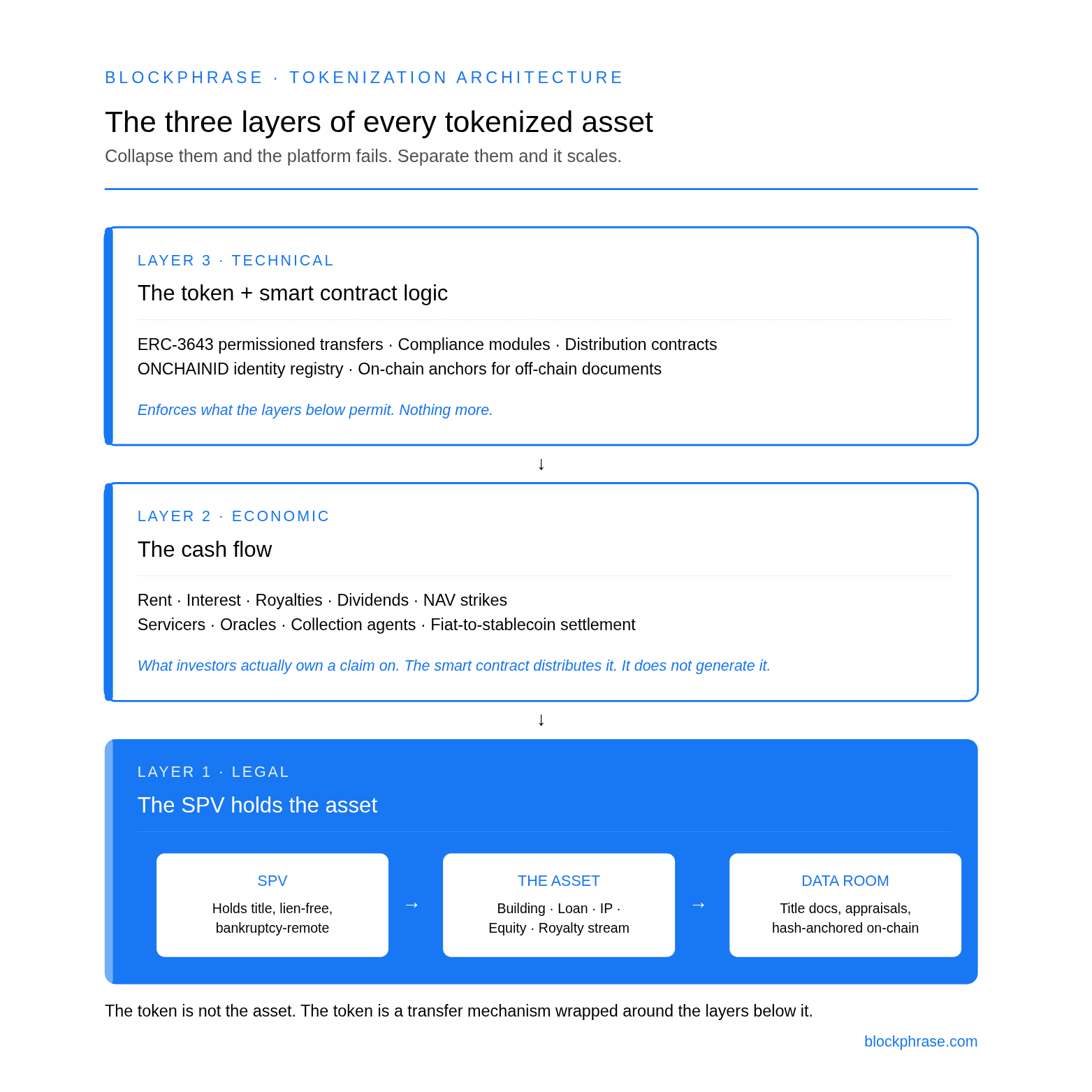
Teams build the token/technology without building the three layers underneath it.
1/The legal layer.
The SPV that actually holds the asset & if a court orders a freeze, this is where the order executes.
2/The economic layer.
The cash flow such as rent, interest, royalties, dividends. What investors actually own a claim on.
3/ The technical layer.
The token and its smart contract logic such as ERC-3643, compliance modules. distribution contracts and more!
The technical layer enforces what the first two layers permit.
Nothing more.
When teams collapse these layers, three things happen.
A. The token transfers cleanly on-chain but the legal claim transfers nowhere.
B. The on-chain compliance is real, however off-chain compliance is missing.
C. The smart contract mints distributions but the bank account stays empty.
Six weeks later that founder had a properly structured DIFC SPV. A transfer agent.
A risk disclosure statement matching VARA's ranked-disclosure rule.
The smart contract was almost unchanged.
The architecture finally matched the marketing.
If your team cannot draw these three layers on a whiteboard, that is the conversation to have before you write more code.
At Blockphrase we work with issuers on exactly this. DM me if you are building or evaluating a platform.