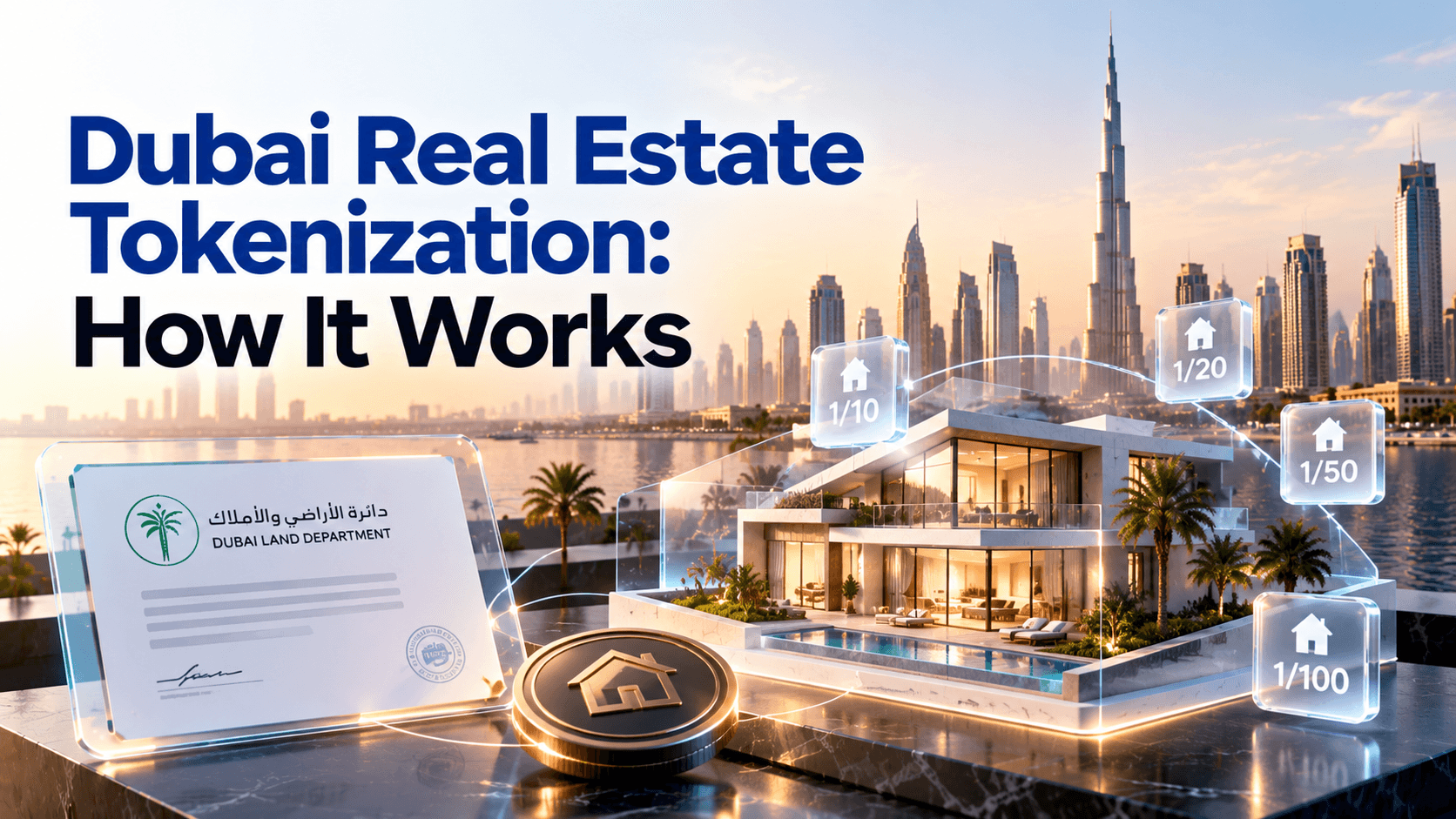
Dubai Real Estate Tokenization: How It Works
Dubai's DLD tokenization pilot records title shares on a blockchain. See how VARA, DIFC and ADGM rules apply, what buyers own and who can invest.
Blockphrase Team
- Published
- Reading time
- 9 min read
Real estate tokenization in Dubai runs through one government channel today: the Dubai Land Department's Real Estate Tokenisation Project, which records fractional shares of a property's title deed on a blockchain and, as of October 2026, is still a controlled pilot in its second phase. Outside that channel, a property token issued in mainland Dubai or its free zones is a virtual asset regulated by VARA, with the federal Capital Market Authority's 2026 regime also in scope, and a token issued from the DIFC or ADGM is usually a security. In each structure the buyer owns something different: a registered share of the title, a share in a company that holds the title, or a contractual claim on income.
How Does the DLD Real Estate Tokenization Project Work?
The Dubai Land Department (DLD) launched the pilot on 19 March 2025 under its REES innovation initiative, with VARA and the Dubai Future Foundation through the Real Estate Sandbox. DLD projects the tokenized market at AED 60 billion by 2033, or 7% of Dubai's real estate transactions: a forecast, not a market size.
On 6 April 2025, DLD and VARA signed an agreement to link the property registry with property tokenization.
The first offering went live on 25 May 2025 through the PRYPCO Mint platform, with the Central Bank of the UAE also involved and Zand Digital Bank as banking partner. DLD set the terms: UAE ID holders only, entry from AED 2,000, and every transaction in dirhams, with no cryptocurrency used during the pilot.
The first property sold out within a day to 224 investors from 44 nationalities, with an average ticket of AED 10,714.
Who Runs the Platform and How Ownership Is Recorded
The platform runs on two VARA-licensed firms. VARA's public register lists Prypco FZE with a Broker-Dealer Services license and Ctrl Alt Solutions DMCC with Broker-Dealer Services and Category 1 VA Issuance, both granted on 24 May 2025.
Ctrl Alt says it minted the title deed ownership tokens on the XRP Ledger, secured by Ripple Custody, through a direct integration with DLD systems. PRYPCO explains that each purchase is recorded on the blockchain and linked to a DLD-issued Property Token Ownership Certificate, which investors can also view in the Dubai REST app.
What Is the Status of Dubai's Tokenization Pilot in 2026?
On 9 February 2026, DLD announced Phase II, opening resale of about 7.8 million tokens from 20 February "within a controlled pilot framework." DLD said more participants and platforms are under study, subject to regulatory approval. According to Ctrl Alt, the first phase covered ten properties worth AED 18.5 million, and Phase II adds asset-referenced "management tokens" to handle secondary transfers.
VARA's alert of 19 February 2026 confirmed that Phase 1 is complete and that Phase 2 is a "controlled testing and evaluation phase." It warned that some firms were citing the initiative in marketing without approval, as an April 2025 alert had also done.
Access has not widened: in September 2026, PRYPCO said a valid Emirates ID is still required, so non-residents without one cannot buy. Its fee guide lists:
- entry costs of a 2% platform fee, a 2% DLD fee (against 4% on a standard purchase) and a 0.1% tokenization fee capped at AED 850;
- a three-month lock-in before resale;
- resale prices limited to within 15% either side of the DLD smart valuation;
- a 1% exit fee on a completed sale.
At launch, Khaleej Times reported in June 2025 that one investor could buy at most 20% of a property's tokens.
How Does VARA Regulate Property-Backed Tokens?
VARA regulates virtual assets across Dubai's mainland and free zones, excluding the DIFC. Since 1 January 2026, Federal Decree-Law No. 33 of 2025 has also brought virtual assets within the federal Capital Market Authority's scope for activity in the UAE outside the DIFC and ADGM, so check both regimes. VARA's Issuance Rulebook sorts issuances into three groups:
- Category 1 covers fiat-referenced and asset-referenced virtual assets (ARVAs). The issuer needs a VARA license.
- Category 2 needs no issuer license, but a licensed distributor must handle placement.
- Exempt tokens are mainly non-transferable or redeemable closed-loop tokens.
The ARVA definition is broad. It covers any token that represents "direct, indirect, current, future or contingent ownership" of a real-world asset, or an entitlement to income from one. VARA's guidance names real estate as a physical asset within that definition.
Under the ARVA Rules:
- Per-token approval. A licensed issuer still needs VARA's approval before issuing each ARVA.
- Whitepaper disclosure. The whitepaper must say whether the token conveys direct ownership, how any fractionalization is structured, and what happens if a token transfer does not settle as a legal transfer of the asset.
- Title follows the token. For direct-ownership tokens, the issuer must make sure ownership is legally established and passes with the token.
- Audits. The circulating number and value must be audited by an independent auditor every six months.
The common mistake is assuming that a token paying only rent escapes all this. VARA's own illustrative example describes a free-zone company issuing a token that pays rental income and sale profits from a Dubai property portfolio. The token carries no ownership and no redemption right. VARA still classifies it as Category 1, requiring a license before issue.
What Do the DIFC and ADGM Routes Offer?
The DIFC's own regulator, the DFSA, launched its Investment Token framework on 25 October 2021. It covers tokens that are securities or derivatives, or substantially similar to one in rights or effect, which takes in tokens over shares in a property company or units in a property fund. An offer of securities to the public needs a DFSA-approved prospectus. Offers within the DFSA's exempt-offer categories, such as offers to fewer than 50 persons in 12 months or at least USD 100,000 per investor, need no prospectus.
The DFSA's Tokenisation Regulatory Sandbox, launched in March 2025, drew 96 expressions of interest, including tokenized property fund units.
In Abu Dhabi Global Market, the FSRA's digital securities guidance (February 2020 version) treats tokens with the features of shares, debentures or fund units as securities. A public offer needs an approved prospectus unless it is an exempt offer. The guidance lists three examples of exempt offers:
- offers to Professional Clients that are not individuals;
- offers to fewer than 50 persons in 12 months;
- offers where each investor pays at least USD 100,000.
It also says the FSRA generally expects the issuer to be incorporated in ADGM.
In both routes, a special purpose vehicle (SPV), often a DIFC or ADGM company or fund, holds the title, and investors own shares in it rather than a place on the DLD register.
| Route | Regulator | What the token represents | Who can invest |
|---|---|---|---|
| DLD Real Estate Tokenisation Project | DLD with VARA | Fractional title deed share, with a DLD certificate | Emirates ID holders (pilot) |
| Mainland or free-zone ARVA | VARA (and federal CMA) | Ownership of, or income from, property | Terms set in each VARA approval |
| DIFC | DFSA | Security token over company shares or fund units | Public with a prospectus, or exempt offers |
| ADGM | FSRA | Digital security over company shares or fund units | Public with a prospectus, or exempt offers |
What Does a Buyer Actually Own in Each Structure?
A registered title share. This is the DLD model and the closest of the three to direct ownership: DLD issues a certificate for your share, and Ctrl Alt says on-chain records stay aligned with the land registry. You are still one co-owner among many; the first property had 224. According to Khaleej Times, a majority vote of investors can decide to sell the whole property.
A share in an SPV. The SPV is the owner on the title deed. Your rights come from its constitution and shareholder agreement, and they are only as strong as its directors, administrator and solvency.
A contractual claim. In VARA's illustrative case, the holder can realize value only by selling the token or in the issuer's wind-down or insolvency. That makes the issuer's credit risk part of the investment.
The token can look identical on-chain in all three cases; the difference sits in the legal and economic layers beneath it, as our post on the legal, economic and technical layers of tokenization explains.
What Are the Main Risks of Tokenized Dubai Property?
- Pilot risk. DLD and VARA describe Phase II as controlled and evaluated, so eligibility, platforms and resale rules can change.
- Thin liquidity. The three-month lock-in, the price band and the Emirates ID requirement all limit who can buy and when.
- Settlement mismatch. A token can move on-chain while the legal transfer fails. VARA requires ARVA issuers to plan for exactly this case.
- Costs. PRYPCO's published fees add about 4.1% on entry and 1% on exit.
- No guaranteed returns. PRYPCO states that its return figures are projections, not guarantees.
- Unapproved offers. VARA has warned twice about firms implying a link to the pilot that they do not have. Check the public register first.
For issuers, our tokenization practice structures the legal wrapper and the token together, for the specific regime the deal has to clear. If you are weighing these routes, book a scoping call.
Frequently Asked Questions
Can non-residents buy tokenized Dubai property through the DLD project?
Not yet. In September 2026, PRYPCO Mint said investors need a valid Emirates ID, so overseas buyers without one cannot take part. Residents of any nationality who hold the ID may qualify. When DLD announced Phase II, it said it was still studying wider participation, subject to evaluation and regulatory approval, so access may change in later phases.
Is a Property Token Ownership Certificate the same as a title deed?
No. A token buyer receives a DLD-issued Property Token Ownership Certificate rather than a title deed of their own. DLD introduced the certificate in May 2025, after the first PRYPCO Mint sale. PRYPCO says it records the investor's tokens, each representing a share of a property registered through DLD, and holdings also appear in the Dubai REST app.
How do investors resell tokens on PRYPCO Mint?
Investors sell tokens on the PRYPCO Mint Marketplace, which opened for resale on 20 February 2026 under DLD's Phase II. PRYPCO applies a three-month lock-in after purchase and limits asking prices to within 15% of the DLD smart valuation. It charges a 1% exit fee when a sale completes. Buyers must also meet the Emirates ID requirement.
Is a token that pays only rental income regulated by VARA?
Yes, if issued in Dubai outside the DIFC. VARA's definition of an asset-referenced virtual asset covers any entitlement to income from a real-world asset, including real estate. In VARA's own example, a token paying rent and sale profits with no ownership or redemption right still needs a Category 1 license, and VARA must approve each such token before issue.
Sources
This article is general information, not legal or investment advice. Rules and markets change; check the primary sources below before acting.
- Dubai Land Department: Dubai Land Department Launches Pilot Phase of the 'Real Estate Tokenisation Project'
- Government of Dubai Media Office: Dubai Land Department and Dubai Virtual Assets Regulatory Authority sign a collaboration agreement
- Dubai Land Department: DLD launches the MENA's first tokenized real estate project through the 'Prypco Mint' platform
- Dubai Land Department: Dubai Land Department Unveils First-of-Its-Kind Property Token Ownership Certificate
- Dubai Land Department: Dubai Land Department launches Phase II of the Real Estate Tokenisation Project
- VARA: Public Register
- VARA: Consumer and Marketplace Alert, Update on the Real Estate Tokenisation Pilot (19 February 2026)
- VARA: Consumer and Marketplace Alert, Misrepresentation of Participation in the DLD Real Estate Tokenisation Project (23 April 2025)
- VARA Rulebooks: Virtual Asset Issuance Rulebook, Part I – Licence Requirements
- VARA Rulebooks: Virtual Asset Issuance Rulebook (full text and definitions)
- VARA Rulebooks: Annex 2, Asset-Referenced Virtual Assets Issuance Rules
- VARA Rulebooks: Guidance on the Virtual Asset Issuance Rulebook, Guidance by Topic
- VARA Rulebooks: Guidance on the Virtual Asset Issuance Rulebook, Illustrative Examples
- Dechert: From SCA to CMA, More Than Just a Rebrand
- DFSA: DFSA introduces regulatory framework for Investment Tokens
- DFSA: The DFSA begins engagement with firms selected for its Tokenisation Regulatory Sandbox
- DFSA Services: Issuers of Securities, Listings and Crypto Token Recognition
- DFSA Rulebook: MKT 2.3.1 Exempt Offers
- ADGM FSRA: Guidance, Regulation of Digital Securities Activities in ADGM
- Ctrl Alt: Ctrl Alt and Dubai Land Department Launch Phase Two of Real Estate Tokenization Project
- PRYPCO: Is Real Estate Tokenization Regulated in Dubai?
- PRYPCO: Tokenized Title Deeds vs SPVs: What's the Difference?
- PRYPCO: Who can invest in tokenized property in Dubai?
- PRYPCO: Real Estate Tokenization Fees in Dubai Explained
- PRYPCO Mint: Tokenized Real Estate and Gold in Dubai
- Khaleej Times: Residents can invest in Dubai real estate for Dh2,000: Tokenisation rules, requirements explained