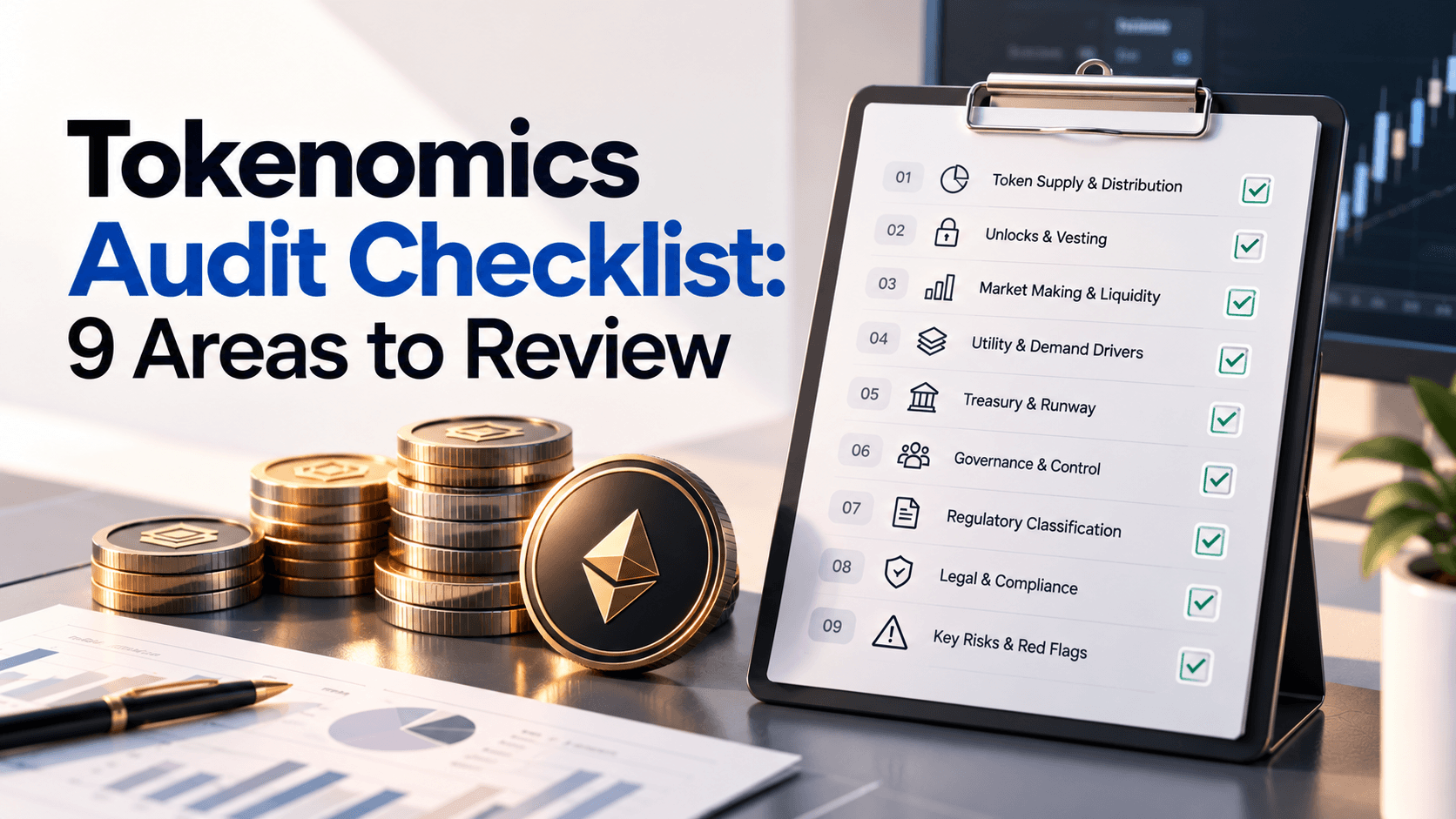
Tokenomics Audit Checklist: 9 Areas to Review
What a tokenomics audit checks across nine areas, from supply, unlocks and market making to governance and MiCA or VARA classification, with red flags.
Blockphrase Team
- Published
- Reading time
- 9 min read
The audit starts with the supply schedule: maximum supply (or none), the emission curve, every mint and burn function, and who can change them. The core question is whether each new token has a matching source of demand.
- Is supply capped or open-ended, and which keys or votes can mint more?
- Does emission fall over time, and what does it pay for?
- Do burns and sinks grow with usage?
Red flag: issuance that outruns every sink. The Block reported in May 2022 that an "unbalanced mint-burn ratio" led to rapid inflation of Axie Infinity's SLP reward token: burning kept pace with issuance for a few months, then issuance pulled ahead, and SLP's price had been falling since late summer 2021.
Red flag: a model that changes after launch. When MANTRA's OM token fell about 90% in April 2025, OKX said it had identified "major changes to the MANTRA token's tokenomics model since Oct 2024," The Block reported. Our $OM tokenomics teardown covers how vesting, emissions and the buyback interacted.
How Are Allocation, Vesting and Unlocks Audited?
Allocation and vesting
The audit checks each bucket (team, investors, treasury, ecosystem, community), its cliff and vesting length, whether vesting is enforced in contracts or only promised in a deck, and whether anyone can amend a schedule after launch.
Red flag: large insider allocations that release in big blocks. Keyrock's study of more than 16,000 unlock events across 40 tokens found that team unlocks triggered the worst price falls, around 25%, while ecosystem development unlocks averaged a gain of 1.18%. Our post on the red flags that predict post-TGE collapse sets out what a healthier vesting structure looks like.
The unlock calendar against float and liquidity
The audit maps every unlock, by month, against circulating supply and the pool and order-book depth available to absorb it. For example, a project with 10% of supply circulating that unlocks another 5% is adding half its float in one event.
The same Keyrock study found that 90% of unlocks create negative price pressure, often starting 30 days before the unlock date. Binance Research estimated in May 2024 that about US$155 billion of tokens would unlock from 2024 to 2030. It linked the trend of tokens launching with low circulating supply and high valuations to selling pressure as those tokens come onto the market.
Red flag: a small launch float, cliffs that multiply circulating supply in the first year, and no liquidity plan for those dates.
Who Do the Token's Incentives Actually Reward?
Incentive loops: staking and liquidity mining
The audit traces where each yield comes from (emissions, fees or a treasury subsidy), how long it can last, and who captures it: long-term users, or capital that leaves when rewards fall.
Red flag: a fixed headline yield with no visible source. In its February 2023 complaint, the SEC alleged that Terraform Labs and Do Kwon marketed UST as paying as much as 20% interest through the Anchor Protocol. Our analysis of why farmers left Berachain when emissions slowed shows the same loop from the liquidity-mining side.
Value accrual and revenue
The audit asks what the token receives today: a share of fees, buybacks and burns, staking distributions, or nothing. It checks whether the mechanism is switched on, who controls it, and whether it is sized against emissions.
Red flag: value accrual that depends on a switch nobody has turned on. Until December 2025, Uniswap's trading fees went entirely to liquidity providers. The "UNIfication" proposal then passed with more than 125 million votes for and 742 against, turning on protocol fees that burn UNI and retroactively burning 100 million UNI, The Block reported. An audit describes what holders receive now, not what governance might switch on later.
Is the Liquidity and Market-Making Setup Sound?
The audit reviews who provides launch liquidity and from which allocation, any token loan as a share of float, call options and profit-sharing terms, reporting duties, spread and depth targets, and the right to recall tokens.
Red flag: a market maker holding a large share of float with a reason to sell. CoinDesk reported that, according to an internal Movement Foundation memo, Movement's contract with Rentech loaned "around half of MOVE's publicly held supply" to a single counterparty, and that a draft let Rentech liquidate if MOVE's fully diluted value exceeded $5 billion. Rentech denies any misrepresentation. In March 2025, Binance said a market maker had placed sell orders for 66 million MOVE a day after listing, made about $38 million, and had its proceeds frozen, CoinDesk reported.
Red flag: volume that is bought rather than made. In October 2024 the SEC charged three so-called market makers, Gotbit, ZM Quant and CLS Global, alleging wash trading that created "the false appearance of an active trading market."
Can Governance or the Treasury Be Captured?
Governance and token concentration
The audit measures top holders' share of voting supply, compares quorum with tokens available to buy, and checks delegation, timelocks, whether voting power is snapshotted before a proposal (which blocks flash-loan voting), and what governance can move.
Red flag: a treasury that a buyer of tokens can vote out. Compound's Proposal 289 passed on 28 July 2024 by 682,191 votes to 633,636. It would have moved 499,000 COMP (about $24 million, 5% of the treasury) to a vault designed by a group led by Humpy, a whale whose group bought COMP on the open market. A Compound security advisor said it "can be considered a governance attack," The Block reported. The transfer was canceled two days later in a truce built around a proposed COMP staking product, The Block reported.
On 17 April 2022, an attacker used a flash loan to exploit Beanstalk's governance and send funds to a wallet they controlled, taking about $77 million in user assets, according to Beanstalk.
Treasury runway
The audit checks how much of the treasury sits in the project's own token, the monthly spend, the runway if the token price halves, and any promise to defend a price or peg.
Red flag: reserves committed to defending a price. The Luna Foundation Guard's bitcoin fell from more than 80,000 BTC on 7 May 2022 to 313 BTC by 16 May, and its reserves from $3.1 billion to roughly $87 million, The Block reported. UST still lost its peg.
What Does the Regulatory Classification Check Cover?
Classification follows the design, so it is checked alongside the economics, not after them.
- EU (MiCA): ESMA's guidelines of 19 March 2025 take a substance-over-form approach: a crypto-asset conferring rights equivalent to shares or bonds is a transferable security. Governance rights solely over technical matters, such as protocol upgrades and fee adjustments, are not share-like, and an expectation of profit alone is not enough.
- Dubai (VARA): under the Virtual Asset Issuance Rulebook, fiat-referenced and asset-referenced tokens (Category 1) need a VARA license; most other tokens (Category 2) need none but must be placed through a Licensed Distributor. Every issuer except those of Exempt VAs publishes a Whitepaper and a Risk Disclosure Statement.
- India: virtual digital asset service providers have been inside the anti-money-laundering framework since March 2023 and must register with FIU-IND whether they are onshore or offshore, the Ministry of Finance said in October 2025. The same release says crypto products and NFTs are unregulated.
Red flag: a token sold as utility whose holders vote on company decisions and receive revenue.
The Tokenomics Audit Checklist at a Glance
| Area | What is checked | Red flag |
|---|---|---|
| Supply and emissions | Cap, mint rights, emissions, sinks | Issuance outruns burns (Axie SLP) |
| Allocation and vesting | Buckets, cliffs, on-chain enforcement | Large team unlocks in blocks |
| Unlocks vs float | Unlocks against float and depth | Cliffs that multiply float |
| Incentive loops | Yield source, duration, who captures it | Fixed headline yield (Anchor) |
| Value accrual | What holders receive today | Value depends on a fee switch left off |
| Market making | Loan size, options, KPIs, recall | Maker holds much of the float (MOVE) |
| Governance | Concentration, quorum, snapshots, timelocks | Treasury votable by bought or borrowed tokens |
| Treasury runway | Own-token share, spend, stress runway | Reserves pledged to defend a price (LFG) |
| Regulatory | MiCA, VARA, India obligations | Share-like rights sold as utility |
How Should a Team Use the Findings?
Rank them: anything that lets someone drain funds or seize governance comes first, then sell pressure, then presentation. The red flags that separate a strong token from a pump-and-dump make a quick first pass.
Blockphrase's tokenomics audit reviews supply, vesting, emissions and incentives from the outside, flags what fails under pressure, and checks MiCA classification against the substance-over-form test at the same time. Findings come in a written report ranked by severity, with an optional walkthrough call.
Frequently Asked Questions
How is a tokenomics audit different from a smart contract audit?
A smart contract audit checks whether code does what its specification says. A tokenomics audit checks whether the specification itself survives the market: supply, unlocks, incentives, liquidity and governance. Governance sits in both. On 17 April 2022 an attacker used a flash loan to exploit Beanstalk's governance process and take about $77 million, Beanstalk said.
Can a token that has already launched still be audited?
Yes. A post-launch audit works from live data instead of a model: actual circulating supply, holder concentration, upcoming unlocks, pool depth and yields. It is often more urgent, because price pressure from an unlock can start 30 days before the date, according to Keyrock's study of more than 16,000 unlock events.
What is a low-float, high-FDV token?
It is a token that launches with a small share of its supply circulating, so a modest market cap implies a large fully diluted valuation. Binance Research warned in May 2024 that this structure leaves little sustainable upside for traders, and estimated about US$155 billion of tokens would unlock from 2024 to 2030.
How can a governance token be used to attack a protocol?
By buying or borrowing enough voting power to pass a proposal that moves treasury funds. Compound's Proposal 289 passed in July 2024 after a group bought COMP on the open market, before the transfer was canceled in a truce, The Block reported. Snapshots taken before a vote, timelocks and quorum set above purchasable float reduce the risk.
Sources
This article is general information, not legal or investment advice. Rules and markets change; check the primary sources below before acting.
- The Block: The decline of Axie Infinity
- The Block: MANTRA investor Laser Digital denies role in OM token crash
- Keyrock: From Locked to Liquidity: What 16,000+ Token Unlocks Teach Us
- Binance Research: Low Float & High FDV: How Did We Get Here?
- SEC: SEC Charges Terraform and CEO Do Kwon with Defrauding Investors in Crypto Schemes
- The Block: Uniswap governance passes major 'UNIfication' proposal
- CoinDesk: Inside Movement's Token-Dump Scandal
- CoinDesk: Binance Offboards Market Maker for Movement's MOVE Token
- SEC: SEC Charges Three So-Called Market Makers and Nine Individuals in Crackdown on Manipulation of Crypto Assets
- The Block: $24 million Compound Finance proposal passed by whale over DAO objections
- The Block: Compound reaches truce with crypto whale Humpy after controversial vote to move $24 million in tokens
- Beanstalk: Beanstalk Governance Exploit
- The Block: Luna Foundation Guard depleted its $3 billion reserves to try to save UST
- ESMA: Guidelines on the conditions and criteria for the qualification of crypto-assets as financial instruments
- VARA: Virtual Asset Issuance Rulebook
- Ministry of Finance (PIB): FIU-IND issues notices for non-compliance to 25 offshore VDA service providers