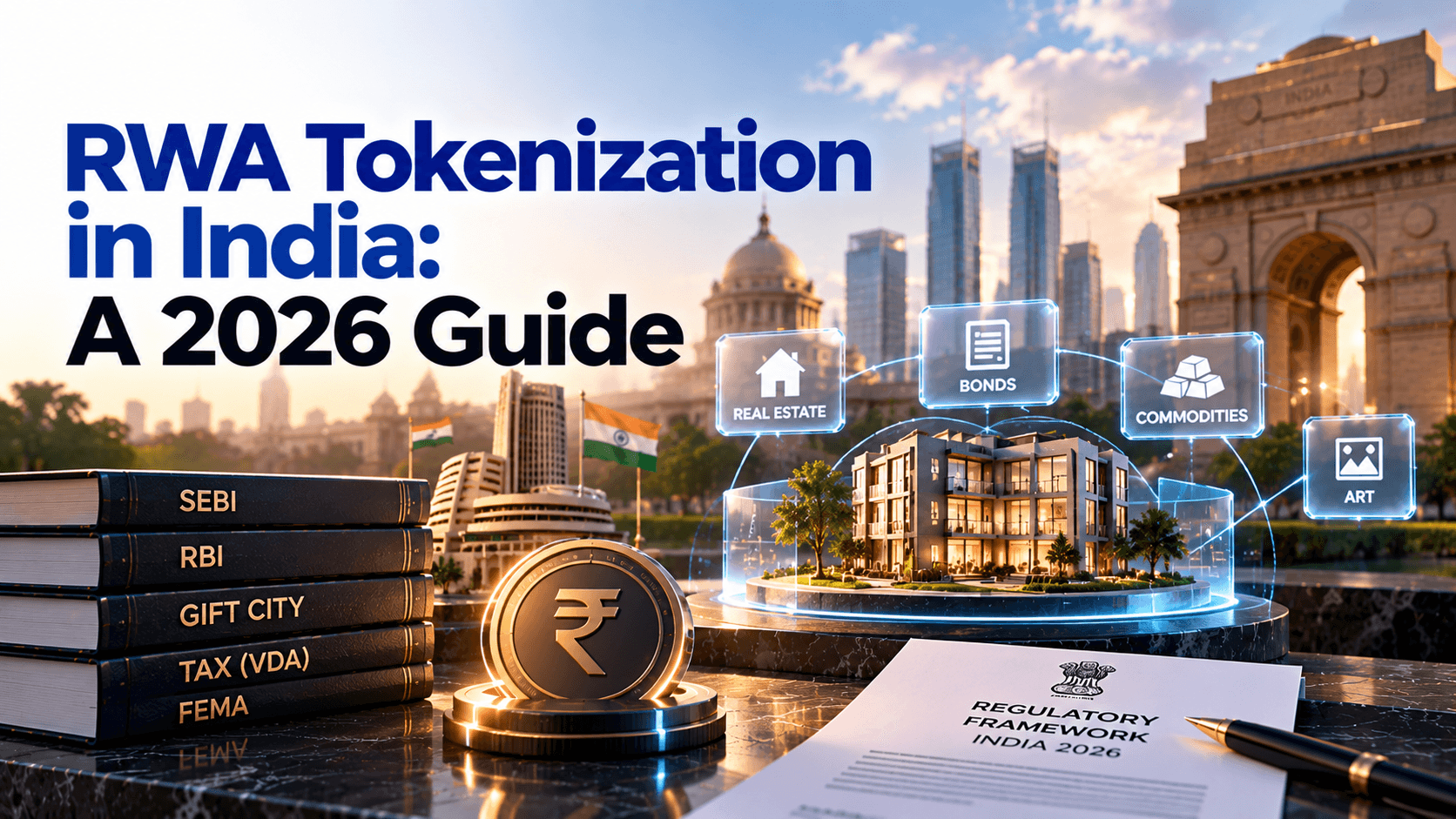
RWA Tokenization in India: A 2026 Guide
Indian law treats a tokenized asset as whatever it represents. This guide covers SEBI's Demat 2.0 and REIT routes, RBI pilots, GIFT City, VDA tax and FEMA.
Blockphrase Team
- Published
- Reading time
- 10 min read
India has no tokenization law, so a tokenized real-world asset takes the legal character of whatever it represents. If the token is a security, SEBI's rules and the depository system apply whatever the technology; if it is not, it is likely a virtual digital asset, taxed at 30% with 1% TDS and supervised by FIU-IND for anti-money laundering. The regulated routes open today are SEBI's fractional vehicles and the SEBI and RBI tokenization pilots; IFSCA in GIFT City has consulted on tokenization but not issued rules.
Current as of October 2026.
How Does Indian Law Treat a Tokenized Asset?
The token's substance decides whether securities law applies. Tax is a separate test, and it can catch a tokenized security too.
The securities lane. In SEBI's bond pilot, a tokenized corporate bond "remains a security under the Securities Contracts (Regulation) Act, 1956", keeps the same ISIN, rating and investor rights, and is not a new asset class (SEBI FAQs on Demat 2.0). The ledger "does not displace the depository's statutory role under the Depositories Act, 1996".
A pooled token can also come under SEBI another way. Under section 11AA of the SEBI Act, a scheme that pools investors' money, is managed for them, gives them no day-to-day control and aims to return profit, income or property is a collective investment scheme (unregistered pooling of ₹100 crore or more is deemed one), and section 12(1B) bars running one without SEBI registration (SEBI Act, 1992). Test a fractional property token against this first.
The virtual digital asset lane. The Income-tax Act, 2025, in force since 1 April 2026, defines a virtual digital asset in section 2(111). Limb (d) covers "any crypto-asset being a digital representation of value that relies on a cryptographically secured distributed ledger or a similar technology … whether or not such asset is included" in the other limbs (Income-tax Act, 2025, Gazette of India). Limb (d) has no carve-out for securities and no public-chain limit. Unless the government excludes an asset by notification, even a tokenized security needs a tax view, and any other token should be assumed to be a VDA until tax counsel concludes otherwise.
A private member's bill introduced in the Rajya Sabha in March 2026, the Asset Tokenisation (Regulation) Bill, 2026, proposes licensing with SEBI or the RBI as regulator by asset type; it is not law (Cyril Amarchand Mangaldas).
What Has SEBI Built for Fractional and Tokenized Assets?
SEBI already fractionalizes real assets, without tokens, through pooled vehicles.
- Small and medium REITs (SM REITs). Each scheme's asset must be worth at least ₹50 crore and less than ₹500 crore. The minimum subscription is ₹10 lakh, and at least 95% of the scheme's value must be in completed, revenue-generating property (SEBI REIT Regulations, as amended to 18 April 2026). Regulation 26N's six-month window for existing fractional-ownership structures to migrate has closed, so new platforms register as SM REITs from the start.
- InvITs. A publicly offered InvIT's minimum subscription falls between ₹10,000 and ₹15,000. A privately placed InvIT may raise money only from institutional investors and body corporates, Indian or foreign, with at least ₹25 lakh from each and from five to 1,000 investors (SEBI InvIT Regulations, as amended to 17 April 2026).
- AIFs. An AIF may not accept less than ₹1 crore from an investor (₹25 lakh for its own employees and directors, and no minimum for accredited investors), and each scheme needs a corpus of at least ₹20 crore (SEBI AIF Regulations, as amended to 14 July 2026).
SEBI's tokenization work is Demat 2.0, whose launch SEBI announced on 10 September 2026 (SEBI press release No. 56/2026). Corporate bonds are issued as native tokens on a private, permissioned ledger owned by the depositories, the depositories hold investors' private keys, and the funds leg settles atomically in e₹. It runs under SEBI's Regulatory Sandbox in three stages, starting with institutional issuance and adding secondary trading and retail access later (SEBI FAQs on Demat 2.0).
REC, L&T and IIFL raised ₹1,025 crore across the first three issues, and the pilot is linked to the RBI's Unified Markets Interface (UMI) (Moneylife).
Where Does the RBI Stand on Tokenization and Crypto?
The RBI is tokenizing regulated instruments while leaving crypto-assets outside any licensing framework.
Its wholesale digital rupee pilot began on 1 November 2022 by settling secondary-market government securities trades (RBI press release, 31 October 2022). The RBI's Annual Report for 2025-26 confirms that a pilot for issuing and trading tokenized certificates of deposit on UMI, settled in wholesale CBDC, has commenced (RBI Annual Report 2025-26, Chapter V).
There is no licensing framework for VDAs. In February 2026 the Minister of State for Finance told the Lok Sabha that VDAs, including crypto, are not currently regulated beyond AML oversight and tax (Business Today). The Ministry has also clarified that FIU-IND registration is not endorsement or licensing (Cyril Amarchand Mangaldas). A structure needing a rupee stablecoin or crypto settlement leg has no licensed Indian route.
Can GIFT City and IFSCA Host a Tokenization Structure?
IFSCA has consulted on tokenization but has not issued rules. Its consultation paper of 26 February 2025 covers funds, bonds, stocks and other real-world assets and excludes cryptocurrencies (IFSCA). The comment deadline of 20 March 2025 was extended to 30 April 2025 (IFSCA notice).
The practical route is IFSCA's FinTech Sandbox Framework of 16 March 2026, which offers regulatory, innovation and inter-operable sandboxes, allows testing for up to 12 months, extendable by six, and lists "tokenization support services" among TechFin activities (IFSCA circular, reproduced by TaxGuru). Treat GIFT City as a sandbox route for a specific structure, not a published licensing path.
How Are Tokens Taxed and Supervised for AML?
Income tax. Under section 194 of the Income-tax Act, 2025, the successor to section 115BBH, income from transferring a VDA is taxed at 30% (plus surcharge and cess), with no deduction other than the cost of acquisition, no set-off of the loss against other income and no carry-forward (Income-tax Act, 2025). Section 393(1) (Table, Sl. No. 8(vi)), which replaces section 194S, requires 1% TDS on consideration for a VDA transfer; section 393(4) (Table, Sl. No. 12) removes the obligation where the year's consideration does not exceed ₹50,000 (specified individuals and HUFs) or ₹10,000 (other payers). Section 509 requires reporting entities to file crypto-asset transaction statements.
AML registration. A notification of 7 March 2023 made five VDA activities, carried out for others in business, reporting-entity activities under the PMLA, including exchange, transfer, safekeeping and "participation in and provision of financial services related to an issuer's offer and sale of a virtual digital asset". FIU-IND says registration is a prerequisite and failure to register attracts action under section 13(2) of the PMLA (FIU-IND).
The 2026 guidelines. FIU-IND's AML and CFT guidelines, updated on 8 January 2026, replaced the 2023 set. They treat anyone offering issuance, underwriting, market-making, placement, sale or distribution services for a VDA as a reporting entity (para 7.1.1), say that running these functions through a smart contract does not relieve the parties of PMLA obligations (para 7.1.2), state that ICO and ITO-related activities "are strongly discouraged" (para 7.1.3), and apply "irrespective of their physical presence in India" (para 7.3) (FIU-IND). They also require an India-based Principal Officer and operationalize the Travel Rule (AZB & Partners).
What Do FEMA Rules Mean for Cross-Border Structures?
- Inbound. Foreign investment is prohibited in "real estate business" (dealing in land and immovable property for profit), with carve-outs including construction development and SEBI-registered REIT units. Foreign equity investment must take the form of equity shares, convertible debentures, preference shares or share warrants, or units of SEBI-registered REITs, InvITs and AIFs (RBI Master Direction on Foreign Investment, updated to 15 June 2026). A token is not on that list, so an offshore token can only wrap an interest the offshore issuer holds in a permitted instrument.
- Outbound. Rule 19 of the Overseas Investment Rules, 2022 bars residents from overseas direct investment in a foreign entity engaged in real estate activity or, without RBI approval, dealing in financial products linked to the Indian rupee. Rule 19(3) limits structures that invest back into India to two layers of subsidiaries (RBI).
- Individuals. Resident individuals can remit up to USD 250,000 per financial year under the Liberalised Remittance Scheme (RBI LRS FAQs). That is a ceiling, not a permission: whether an offshore token is a permitted overseas investment is a separate question under the OI Rules.
Which Routes Are Open to Issuers Today?
| Route | Regulator | Who invests | What the token is | Status, October 2026 |
|---|---|---|---|---|
| SM REIT | SEBI | ₹10 lakh minimum | Not needed; pooled units | In force |
| Private InvIT | SEBI | Institutions and body corporates; ₹25 lakh minimum | Not needed; pooled units | In force |
| AIF | SEBI | ₹1 crore minimum | Not needed; pooled units | In force |
| Demat 2.0 bonds | SEBI with RBI | Institutions first | The bond itself, depository-held | Sandbox pilot |
| UMI certificates of deposit | RBI | Pilot participants | Tokenized money market instrument | Pilot |
| GIFT IFSC | IFSCA | Sandbox participants | Not yet defined | Consultation 2025; sandbox 2026 |
| Offshore token, Indian asset | Foreign regulator plus FEMA | Foreign investors; residents within LRS and OI Rules | Per host jurisdiction | Case by case |
| Unregulated Indian token | FIU-IND (AML); SEBI if it is a CIS | Anyone; no investor protection regime | Likely a VDA; possibly a CIS | Taxed as VDA (30%, 1% TDS) |
For Indian assets sold to Indian investors, the options are a SEBI vehicle without a token, a regulator's pilot, or the VDA lane with its tax and AML costs. Blockphrase structures the legal wrapper and the token together, for the regulatory regime the deal actually has to clear; our RWA tokenization service and regulatory advisory practice set out how.
Where Do Tokenization Projects in India Go Wrong?
- Building the token before the wrapper. A token that transfers on-chain while the legal claim transfers nowhere, because no SPV holds the asset, is the failure we describe in the common failures of tokenization in 2026.
- Assuming "not a security" means unregulated. A pooled token may be a collective investment scheme; otherwise VDA tax and FIU-IND registration follow.
- Running an issuance without FIU-IND registration. Issuer offer services are a listed activity, and the 2026 guidelines strongly discourage token offerings.
- Ignoring FEMA in an offshore structure. An offshore token over Indian property is still tested against the real estate prohibition and ODI rules. Our note on regulation and enforcement in India covers how firms without a compliance route end up exposed.
- Treating pilots as products. Demat 2.0 and UMI run on regulated market infrastructure, not on new platforms.
Classification comes before design in Blockphrase's methodology.
Frequently Asked Questions
Is a tokenized corporate bond in India still a security?
Yes. SEBI's Demat 2.0 FAQ says a corporate bond issued in tokenized form under the pilot remains a security under the Securities Contracts (Regulation) Act, 1956, and keeps the same ISIN, rating and investor rights. The depository stays the authoritative record of ownership; tokenization changes only the technology that keeps the record.
Are tokenized real-world assets taxed as virtual digital assets in India?
They can be. The Income-tax Act, 2025 defines a virtual digital asset to include any crypto-asset relying on a cryptographically secured distributed ledger, unless the government excludes it by notification. Any token on a distributed ledger, including a tokenized security, should be tested against that definition, because VDA income is taxed at 30% with 1% TDS on transfers.
Does a tokenization platform need to register with FIU-IND?
Yes, if it provides any of the five notified VDA services for others in the course of business, which include services related to an issuer's offer and sale of a VDA. FIU-IND treats registration as a prerequisite, its January 2026 guidelines name issuance, placement and distribution services, and they apply whether or not the provider is physically in India.
Can foreign investors buy tokens backed by Indian real estate?
Only within FEMA limits. Foreign investment is prohibited in Indian "real estate business" (dealing in land and property for profit), although SEBI-registered REIT units are carved out. Foreign investors can hold only permitted instruments, such as company shares or REIT units, so an offshore token can represent only an interest its issuer holds in one of those.
What is the minimum investment in a SEBI small and medium REIT?
₹10 lakh. SEBI's REIT Regulations set the minimum subscription from any investor in an SM REIT offer at ₹10 lakh, for schemes acquiring assets worth at least ₹50 crore and less than ₹500 crore. At least 95% of each scheme's value must be in completed, revenue-generating real estate.
To test a specific structure against these rules, book a scoping call.
Sources
This guide is general information, not legal advice. Rules and regulator guidance change; check the primary sources below before acting.
- SEBI: Successful launch of "Demat 2.0" Pilot project for Tokenised Corporate Bonds (PR No. 56/2026)
- SEBI: FAQs on Demat 2.0, Pilot for Tokenised Corporate Bonds
- SEBI: Securities and Exchange Board of India Act, 1992
- SEBI: Real Estate Investment Trusts Regulations, 2014 (last amended 18 April 2026)
- SEBI: Infrastructure Investment Trusts Regulations, 2014 (last amended 17 April 2026)
- SEBI: Alternative Investment Funds Regulations, 2012 (last amended 14 July 2026)
- Gazette of India: The Income-tax Act, 2025 (Act 30 of 2025)
- FIU-IND: Registration of Virtual Digital Asset Service Providers as Reporting Entities (4 July 2023)
- FIU-IND: AML & CFT Guidelines for Reporting Entities Providing Services Related to Virtual Digital Assets (updated 8 January 2026)
- IFSCA: Consultation Paper on Regulatory Approach towards Tokenization of Real-World Assets (26 February 2025)
- IFSCA: Notice extending the deadline for the tokenization consultation paper (19 March 2025)
- TaxGuru: IFSCA FinTech Sandbox Framework, Circular No. 505/IFSCA-FTec0FTEF/1/2023 (16 March 2026)
- RBI: Operationalisation of Central Bank Digital Currency, Wholesale (e₹-W) Pilot
- RBI: Annual Report 2025-26, Chapter V, Financial Markets and Foreign Exchange Management
- RBI: Foreign Exchange Management (Overseas Investment) Rules, 2022
- RBI: Master Direction, Foreign Investment in India (updated to 15 June 2026)
- RBI: Liberalised Remittance Scheme FAQs
- AZB & Partners: AML & CFT Guidelines for Reporting Entities Providing Services Related to Virtual Digital Assets, 2026
- Cyril Amarchand Mangaldas: India's First Asset Tokenisation Bill
- Cyril Amarchand Mangaldas: India Digital Assets Round-Up, Recent Regulatory and Market Developments
- Moneylife: SEBI, RBI Launch 'Demat 2.0' Pilot for Tokenised Corporate Bonds, 3 Issuers Raise ₹1,025 Crore
- Business Today: Crypto still unregulated, but under tax and enforcement radar, FinMin in Parliament