Token Vesting: Designing Unlocks That Hold
Why large token unlocks pressure prices, what Keyrock's study of 16,000+ unlocks found, and how to design cliffs, linear vesting and calendars that hold.
Blockphrase Team
- Published
- Reading time
- 8 min read
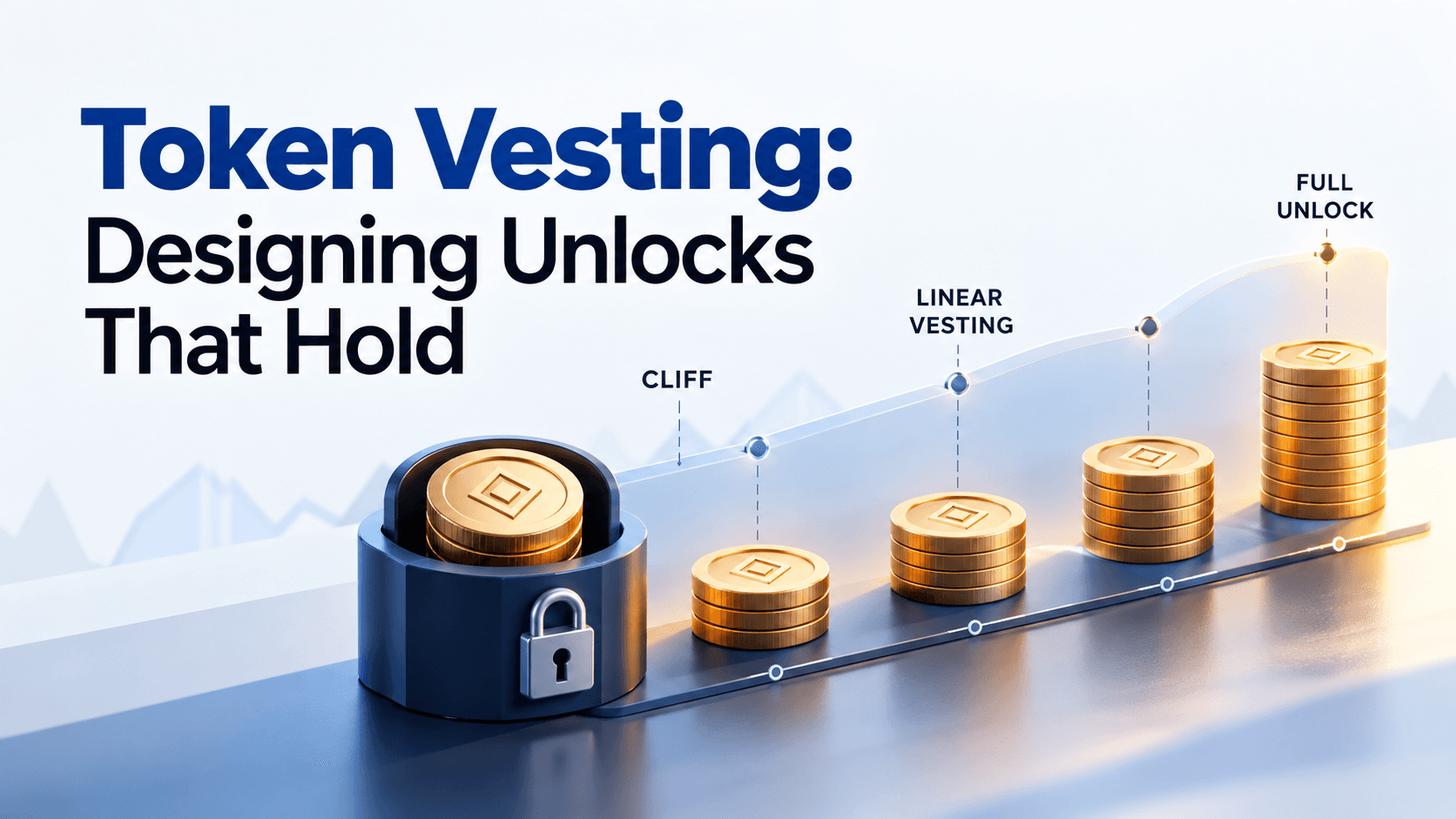
Large token unlocks pressure prices because they add sellable supply on a known date, and the market starts pricing that supply weeks before it arrives. Keyrock's study of more than 16,000 unlock events found that "90% of unlocks create negative price pressure, regardless of size or type." Vesting that holds is designed around three variables: who receives the tokens, how large each release is against supply and liquidity, and how predictable the calendar is.
Why Do Token Unlocks Push Prices Down?
The most useful public dataset is Keyrock's From Locked to Liquidity: What 16,000+ Token Unlocks Teach Us, published on 5 December 2024. The sample was "16,000+ unlock events across 40 tokens"; it gives no date range, and no baseline or window for its 2.4x and -25% figures. Daily prices were tracked for 30 days before and after each event and weighted against ETH to reduce the effect of general market moves.
Its headline findings, quoted from the study:
- "Token price impacts often start 30 days before the unlock event."
- "Bigger unlocks lead to sharper price drops (2.4x) and increased volatility."
- "Team unlocks trigger the worst crashes (-25%) with unsophisticated sell-offs."
- "Ecosystem development unlocks are among the few with positive effects (+1.18% on average)."
For larger unlocks, Keyrock saw drawdowns through the prior 30 days, "with the decline accelerating in the final week," and prices that "tend to stabilise within roughly 14 days." It attributes the early drop to recipients hedging in advance and to retail traders selling to avoid dilution.
Arbitrum shows the pattern in one event. Its documentation sets "4 year lockups" for all team and investor tokens, with the first unlock one year after the 16 March 2023 token generation event and monthly unlocks after that. On 16 March 2024, Cointelegraph reported, 673.5 million ARB unlocked for the team and advisers and 438.25 million for investors, all at once. ARB traded at $2.22 on 13 March and $1.84 on the unlock day. Those are raw prices, not adjusted for the wider market.
Cliff or Linear Vesting: Which Holds Better?
A cliff is a period with no release. Linear vesting releases equal amounts on a fixed cadence. Keyrock describes the common hybrid: nothing over roughly the first third of the vesting period, "a substantial chunk" at the cliff, then linear release. "Batch Unlocks" release everything when the cliff ends; other schedules are linear from day one.
On the trade-off, the study is direct: "Linear unlocks outperform initial cliff unlocks in reducing short-term disruption, though larger cliffs often recover better after 30 days." It also found that unlocks above 10% of supply performed "as well or even better than" those of 5% to 10%, possibly because they cannot be fully hedged or sold within 30 days.
A cliff still makes recipients commit before they are paid; the risk sits in the tranche it releases. Arbitrum's team and investor allocations total 4.447 billion tokens, so its one-year cliff released a quarter of both groups' tokens on one day.
Does It Matter Who Receives the Unlocked Tokens?
Yes. Keyrock's data separates team, investor, ecosystem development and community unlocks:
- Team unlocks were the most damaging. Keyrock points to uncoordinated selling by individuals who treat tokens as deferred pay, and to a lack of hedging. In its ApeCoin case, a linear team unlock released 0.7% of total supply a month from 1 March 2023; over the next seven months APE fell 77% while ETH fell 9%, which Keyrock attributes to weak interest in APE as well as team selling.
- Investor unlocks showed "controlled price performances," with "data from 106 events showing a consistent trend: slow, minimal price declines." Keyrock credits OTC sales, TWAP and VWAP execution, and hedging.
- Ecosystem development unlocks dipped before the event and rose after it, when tokens funded liquidity, incentives or grants. Keyrock's example is Optimism's June 2022 Governance Fund unlock, after which 36 million OP went to 24 projects over 60 days.
- Community unlocks had limited long-term effects, since many recipients hold.
So the team schedule deserves the most conservative design. Keyrock suggests teams "could mitigate this by working with market makers to minimise impact." In practice: a slower post-cliff release for contributors, a coordinated sale window or OTC route, and ecosystem releases tied to a funded program rather than a date.
How Big Is Too Big for One Unlock?
Keyrock sizes each event as a share of token supply: nano (under 0.1%), micro (0.1% to 0.5%), small (0.5% to 1%), medium (1% to 5%), large (5% to 10%) and huge (above 10%). For a cliff tranche, its formula is "Total Unlock % of Supply × Cliff %."
Supply share is half the test; the other half is liquidity. For example, a project that unlocks 10 million tokens into a market trading 2 million a day is asking buyers to absorb five days of total volume. Measure every scheduled event against average daily volume and order-book depth, not only circulating supply. An event worth several days of volume needs a smaller tranche, a longer linear tail, or a liquidity plan agreed in advance.
Staggering
The second sizing error is stacking. Arbitrum's team and investor cliffs fell on the same date, turning two allocations into one event. Offsetting cliffs by recipient group, and keeping monthly releases away from other large events, spreads the same supply across smaller windows. Frequency is not free either: outside large and huge events, Keyrock saw "consistent downward price pressure from smaller, steady unlocks."
Milestone-Linked Vesting
Performance- or milestone-linked vesting releases tranches when a defined condition is met, such as a mainnet launch or a usage threshold. It ties supply to progress but adds two risks: a metric that can be gamed, and a release date the market cannot predict. Define the milestone in objective, verifiable terms, cap each tranche, and publish the rule in advance.
Rescheduling After Launch
Every change to a schedule is a market event. In July 2024 a Worldcoin blog post said "the unlock schedule for 80% of the WLD held by TFH's team members and investors is being extended from 3 to 5 years," The Block reported, with daily linear unlocks due from 24 July. TFH is Tools for Humanity. CoinDesk reported a 15% rise in WLD after the announcement. A schedule that keeps moving tells the market the first one was wrong, as our $OM tokenomics case study discusses.
Vesting Structures Compared
| Structure | How it works | Main risk | When it fits |
|---|---|---|---|
| Batch (cliff only) | Whole allocation released when the cliff ends | One large supply event, priced in weeks ahead | Small allocations only |
| Cliff plus linear | Nothing during the cliff, a tranche at the cliff, then monthly or daily release | The cliff date becomes the event | Team and investors, with a modest cliff tranche |
| Linear, no cliff | Equal releases from the start | Steady, smaller pressure | Community and ecosystem programs |
| Milestone-linked | Tranches release when a defined condition is met | Gameable metrics, unpredictable dates | Ecosystem funds and contributor grants |
| Staggered by group | Each recipient group's cliff on a different date | More events to track and disclose | Any schedule with several large groups |
How Should Vesting Be Enforced and Published?
A schedule in a whitepaper is a promise; a vesting contract enforces it. OpenZeppelin's VestingWallet uses "a linear vesting curve" by default, and its VestingWalletCliff extension "adds a cliff to the vesting schedule," available since version 5.1. The documentation carries a warning teams overlook: "Since the wallet is Ownable, and ownership can be transferred, it is possible to sell unvested tokens." OpenZeppelin adds that preventing this in a smart contract is difficult, because a beneficiary can itself be a contract, so back the vesting contract with written lock-up terms.
The deployed parameters must match the published schedule, a red flag we covered in why crypto projects collapse after TGE. Then publish a calendar with dates, amounts and recipient groups. Traders will check it: Keyrock tells them to "always review unlock calendars" on trackers such as CoinGecko. The Block reported in December 2025 that Hyperliquid had planned to reserve about 23.8% of HYPE supply for core contributors, that the first team allocation of about 1.75 million tokens came on 29 November, and that "the full Hyperliquid Labs vesting timetable does not appear to be publicly available."
How Do Simulations Test an Unlock Schedule Before Launch?
A tokenomics simulation runs the schedule against market conditions before it is written into a contract, in three passes:
- Deterministic mapping. Lay every unlock, by date and recipient group, against projected circulating supply and liquidity. This shows where events stack and how many days of volume each represents.
- Stochastic runs. Run the calendar across many price and volume paths, including low-liquidity periods, to expose a schedule that only works in a rising market.
- Adversarial scenarios. Assume a recipient group sells without hedging or coordination, the pattern Keyrock describes for team unlocks, and measure the price path and the depth needed to absorb it.
Sensitivity analysis then shows which lever matters most: cliff length, cliff tranche, cadence or the order of recipient groups.
At Blockphrase, tokenomics design builds utility, supply, vesting and incentives as one system, with the unlock calendar tested in simulation before launch. If you are setting a schedule now, book a scoping call.
Frequently Asked Questions
Do token unlocks always push the price down?
Not always, but usually. Keyrock's study of 16,000+ unlock events across 40 tokens, published in December 2024, found that 90% created negative price pressure. Ecosystem development unlocks were among the few with positive effects, averaging +1.18%, because those tokens often funded liquidity, incentives or grants.
What is the difference between a cliff and linear vesting?
A cliff is a period during which no tokens are released, often followed by one larger tranche when it ends. Linear vesting releases equal amounts on a fixed schedule, such as monthly or daily. Keyrock found linear unlocks caused less short-term disruption, while larger cliffs often recovered better after 30 days.
How large can a single token unlock be?
There is no fixed limit, but size should be measured two ways. Keyrock classes unlocks above 5% of supply as large and above 10% as huge. The practical test is liquidity: compare each release with average daily trading volume and order-book depth, and shrink or spread any event the market cannot absorb.
Can a project change its vesting schedule after launch?
Yes, if its contracts and agreements allow it, but every change becomes a market event. In July 2024 the unlock schedule for 80% of the WLD held by Tools for Humanity's team and investors was extended from three to five years. Changes should be rare, announced in advance and reflected in the deployed contracts.
Sources
This article is general information, not legal or investment advice. Rules and markets change; check the primary sources below before acting.
- Keyrock: From Locked to Liquidity: What 16,000+ Token Unlocks Teach Us
- Arbitrum Foundation: $ARB airdrop eligibility and distribution specifications
- Cointelegraph: Arbitrum whales move $58M to exchanges after token unlock
- The Block: Worldcoin token jumps over 20% with unlock for early contributors starting next week, period extended
- CoinDesk: Sam Altman's Worldcoin Surges 15% as Investor and Team Lockup Extended
- OpenZeppelin: Finance (VestingWallet and VestingWalletCliff)
- The Block: Hyperliquid Labs set for next HYPE token payout as 1.2 million tokens unstake